
Second Amendment to the Banking Offence and Punishment Act, 2064 (2008)

The Ministry of Law, Justice and Parliamentary Affairs, under the Government of Nepal, issued the Second Amendment to the Banking Offence and Punishment Act, 2064 (2008) (“Banking Offence Act”) through publication in the Nepal Gazette on 24 Baisakh 2082 (06 May 2025). The amendment introduces significant changes aimed at strengthening the regulatory framework around cheque dishonor/bounce, including a formal definition of cheque dishonor/bounce, detailed procedural requirements for banks, criminal and civil liabilities, and the recognition of compromise (Milapatra) between parties.

The key points of the amendment are as follows:

1. Statutory Definition of “Cheque Dishonor/Bounce”

The amendment defines “Cheque Dishonor/Bounce” (चेक अनादर) under Section 2(l) of Banking Offence Act as a situation where a bank, financial institution, or cooperative bank certifies that the payment cannot be made to the cheque holder due to insufficient funds in the relevant bank account of the cheque drawer, when the holder demands payment of the amount mentioned in the issued cheque.

2. Certification of Cheque Dishonor/Bounce

Previously, when a cheque was returned unpaid due to insufficient funds, banks and financial institutions would immediately issue a dishonor/bounce notice to the cheque holder upon presentment.

Now, with the amendment Section 3A has also been introduced to the Banking Offence Act, which provides that the cheque holder must request the concerned bank, financial institution, or cooperative bank to formally certify the cheque as dishonored/bounced. Before certifying a cheque as dishonored/bounced, banks and financial institutions or cooperative bank are required to undergo a due process, as detailed in the table below:

Steps

Procedure

Step 1If a cheque presented for payment cannot be honored due to insufficient funds, the bank must issue a notice to the cheque drawer, granting up to 45 days to deposit the required amount.
Step 2This notification must be recorded and issued through any appropriate means.
Step 3If the account remains unfunded beyond the notice period, the cheque must be marked accordingly and returned to the cheque holder.
Step 4The bank must formally certify the dishonor/bounce and return the cheque to the holder within 3 days, with a written endorsement stating the dishonor/bounce was due to lack of sufficient funds.

3. Civil and Criminal Liability of Account Holders

Previously, as per Section 107A of the Negotiable Instruments Act, 2034 (1977) (“Negotiable Instruments Act”), the drawer would be liable to repay the cheque amount with interest to the cheque holder and could face up to 3 months’ imprisonment, a fine up to NPR 3,000, or both in the case of cheque dishonor/bounce.

Now, Section 107A of the Negotiable Instruments Act has been repealed by the amendment.

Now, as per the amendment Section 15(1A) has also been introduced to the Banking Offence Act, which provides that in the event of certified cheque dishonor/bounce, the account holder will be liable to:

a) Repay the full cheque amount to the cheque holder;

b) Pay statutory interest from the date of cheque issuance to the date of actual repayment; and

c) Bear a penalty of 5% of the dishonored/bounced amount.

In addition, the aforementioned liability, the Section 15(1A) of the Banking Offence Act, introduces graded imprisonment based on the amount involved, as detailed in the table below:

Cheque Amount (Bigo)Imprisonment Term
Up to NPR 1.5 millionUp to 1 month
NPR 1.5 million to NPR 5 million1 to 3 months
NPR 5 million to NPR 10 million3 months to 1 year
NPR 10 million to NPR 100 million1 to 2 years
Above NPR 100 million2 to 4 years
Note: If the person committing the offence is the chairman, director, or chief executive officer of the concerned institution, they will be imprisoned for an additional 1 year.

4. Time Limitation for Legal Action

With the amendment to Banking Offence Act, FIR concerning cheque dishonor/bounce must be lodged within 1 year from the date of certified dishonor/bounce. Following such complaint, a lawsuit must be filed in the relevant District Court within 6 months.

 5. Recognition of Compromise (Milapatra) Mechanism

One of the notable progressive features introduced by the amendment is the formal recognition of compromise (Milapatra) as a legitimate resolution mechanism in cheque dishonor/bounce cases. Under the new framework:

a) Parties can file a joint application for compromise before the investigation concludes (through the investigating officer and government attorney), or after the matter is sub judice (through the government attorney to the court).

b) Upon verification of full payment to the cheque holder, the matter can be amicably settled.

c) Once such a compromise is approved, the accused will not be subject to further prosecution or punishment under the Banking Offence Act.

Disclaimer: This article is for general informational purposes only and does not constitute legal advice, advertisement, personal communication, solicitation or inducement. No attorney-client relationship is created through this content. Gandhi & Associates assumes no liability for any consequences resulting from actions taken based on information contained herein.

For quick legal assistance:

Phone/Viber/WhatsApp: +977 9709035477

For specific legal advice regarding cheque dishonor/bounce in Nepal, please contact our office to schedule a consultation with our experts.
Termination of Employment: Labour Laws in Nepal

Termination of employment refers to the lawful end of the employment relationship between an employer and an employee. As per Section 139 of Labour Act, 2074 (2017), the employment of an employee must be terminated only on the grounds as provided under the labour laws.  The employee must be provided with a proper and sufficient reason when terminating the employment.

Under Nepalese labour law, termination can occur on various grounds including expiry of the term, resignation, retirement, non-performance, misconduct, or retrenchment.

This article provides a general overview on the grounds of termination as per Labour Act, 2074 (2017) and Labour Regulations, 2075 (2018).

I. Grounds for termination of employment

The grounds of termination of employment in Nepal pursuant to the prevailing labour laws are provided below:

1. Termination upon expiry of the term of employment

Type of EmploymentCondition for TerminationException
Time-based EmploymentTerminates upon expiry of the duration specified in the employment agreement.If the employment is project-based and the duration is extended due to the nature of work, termination will be deferred accordingly.
Work-based EmploymentTerminates upon completion of the specific work mentioned in the employment agreement.If the employment is project-based and the work is added or extended based on its nature, employment continues until completion.
Casual EmploymentCan be terminated at the discretion of either the employer or the employee.N/A

 2. Voluntary Resignation by the Employee

An employee can resign by submitting a written resignation to the employer. The employer is required to formally accept the resignation within 15 days. If no response is provided within this period, the resignation is deemed accepted automatically from the following day.

However, the resignation may be withdrawn through mutual consent between the employer and the employee.

3. Termination on the Ground of Incompetence

An employer can terminate an employee if their work performance is found to be unsatisfactory or poor for 3 (three) or more consecutive years, based on evaluations conducted in accordance with the labour laws or enterprise by-laws.

In case the enterprise employs 10 (ten) or more employees, the employer must allow the employee at least 7 (seven) days to submit a clarification before proceeding with such termination.

4. Termination on the Ground of Health

Employment can be terminated if an employee becomes incapable of performing their duties due to physical or mental incapacity, serious injury, or prolonged medical treatment, based on a medical doctor’s recommendation.

However, the law protects employees undergoing treatment for workplace accidents or occupational diseases, prohibiting termination during hospital treatment or within 1(one) year of home treatment. For other medical conditions, termination is not permitted within 6 (six) months, unless there is a medical recommendation for earlier termination. If the employee is still able to work in a different capacity, the employer must offer suitable alternative work instead of terminating the employment.

5. Termination on the Ground of Misconduct

An employer can terminate an employment of an employee in case such employee is engaged in following misconduct:

S.N.Misconducts
1.Engaging in physical assault or causing physical harm to any person related to the employer, customer, or workplace.
2.Using any form of weapon or committing vandalism within the employer’s office premises.
3.Receiving or granting a bribe.
4.Committing theft against any person within the workplace.
5.Remaining absent from work for more than 30 consecutive days without approved leave.
6.Intentionally damaging the employer’s property.
7.Embezzling the employer’s finances.
8.Breaching the employer’s confidentiality, including with respect to products, technology, or formulae.
9.Engaging in business activities with a competing enterprise, starting a competing business, or disclosing confidential information.
10.Submitting fake educational or other certificates for the purpose of appointment.
11.Consuming narcotic substances or liquor during working hours or coming to work under their influence.
12.Being convicted by a court of a criminal offense involving moral turpitude during employment.
13.Committing any act of misconduct for which dismissal is prescribed by law.
14.Being punished more than twice within three years for misconduct resulting in reprimand, one-day pay deduction, or withholding of promotion/salary increment for one year.

6. Compulsory Retirement

Employees in regular employment must retire upon reaching the age of 60. However, for specific types of work, an earlier age of retirement can be prescribed in the enterprise’s by-laws, subject to prior approval from the Central Labour Advisory Council.

7. Retrenchment

An employer can retrench employees in situations where the enterprise faces financial difficulties, undergoes merger or restructuring, or requires partial or complete closure for any valid reason.

Procedure for Retrenchment

Before carrying out retrenchment, the employer must provide at least 30 (thirty) days’ advance notice to the Labour and Employment Office and to the authorized trade union (or labour relation committee, if no union exists), detailing the grounds, timeline, and number of employees likely to be affected.

The employer is then required to engage in consultations with the union or labour relation committee to explore alternatives to retrenchment and to agree on the selection criteria. If no agreement is reached or the union declines to engage, the employer can proceed by notifying the Labour and Employment Office.

Order of retrenchment

The general order of retrenchment is as follows:

  1. Foreign workers,
  2. Employees with a history of disciplinary action,
  3. Employees with consistently weak performance, and
  4. Last hired among employees performing the same type of work.

Eligible employees who have served for at least 1 (one) year are entitled to compensation equal to 1 (one) month’s basic remuneration for each year of service, proportionately adjusted for service under 1 (one) year. This compensation is not applicable if the employee receives unemployment allowance under applicable social security laws.

Inapplicability of retrenchment provisions

These retrenchment provisions do not apply to:

  • Employers with 10 or fewer employees,
  • Retrenchments pursuant to a Government of Nepal or Labour Court order,
  • Enterprises located in Special Economic Zones where separate retrenchment provisions apply.

II. Notice Period

Except in cases where employment is terminated due to serious misconduct, both the employer and the employee are required to provide prior notice before ending the employment relationship.
The notice period depends on the duration of employment:

S.N.Duration of EmploymentMinimum Notice Period
1.Up to 4 weeksAt least 1 day
2.More than 4 weeks and up to 1 yearAt least 7 days
3.More than 1 yearAt least 30 days

If the employer fails to provide the required notice, they must compensate the employee with an amount equal to the remuneration for the notice period. Conversely, if an employee resigns without giving proper notice, the employer is entitled to deduct the equivalent amount from any remuneration due to the employee.

III. Payment of Benefits

Upon termination of employment, whether due to misconduct or any other reason, the employer is legally required to settle all outstanding dues and benefits of the employee. The key provisions are as follows:

a) Timeline for Payment

The employer must pay all remuneration and benefits due to the employee within 15 (fifteen) days of the date of termination.

b) Assistance with External Claims

The employer must also assist the employee in claiming any benefits payable from third parties such as the Social Security Fund, insurance providers, or other relevant institutions.

c) Penalty for Delay in Payment

If the employer fails to pay the due amount or extend the required assistance within the prescribed time, the employee is entitled to continue receiving remuneration as if still in service, until such payment is made.

d) Non-appearance of Employee

If the employee does not appear to collect their payment, the employer can either transfer the payment to the employee’s bank account or deposit it with the Labour and Employment Office.

Disclaimer: This article is for general informational purposes only and does not constitute legal advice, advertisement, personal communication, solicitation or inducement. No attorney-client relationship is created through this content. Gandhi & Associates assumes no liability for any consequences resulting from actions taken based on information contained herein.

For quick legal assistance:

Phone/Viber/WhatsApp: +977 9709035477

For specific legal advice regarding termination and related procedural matters in Nepal, please contact our office to schedule a consultation with our experts.

Layoff versus Retrenchment

1. What is Layoff? [(Section 15 of Labour Act, 2074 (2017)]

A layoff, also referred to as holding a worker in reserve, is a temporary suspension of work due to special circumstances that are beyond the employer’s control. Such circumstances may include shortages of electricity, water, or raw materials; financial constraints; or physical inaccessibility to the workplace.

A layoff does not terminate the employment relationship. Instead, it suspends the employee’s active duties while maintaining their employment status.

Duration and Conditions

Employers with 10 (ten) or more employees can hold workers in reserve for up to 15 (fifteen) days. If the layoff period needs to be extended beyond this limit, the employer must consult with the authorized trade union or the labour relation committee.

Notice Requirements [(Rule 5 of Labour Regulations, 2075 (2018)]

Before placing any employee on reserve, the employer is required to serve a notice to the concerned employee. The notice must include:

a) The reason for the layoff,

b) The intended duration of the layoff,

c) Name, position, and job description of the affected worker,

d) A statement confirming the worker will receive 50% of their remuneration during the layoff period,

e) Any other relevant information the employer deems necessary.

Where only some employees are placed on reserve, the employer must, as far as possible, implement a rotational system among workers performing similar types of work and indicate this clearly in the notice.

Remuneration and Employee Rights

During the layoff period, affected employees are entitled to half of their basic remuneration. Since the employment relationship remains intact, laid-off workers retain all legal entitlements related to continuity of service, benefits, and recall rights.

2. What is Retrenchment? [(Section 145 of Labour Act, 2074 (2017)]

Retrenchment refers to the permanent reduction of the workforce due to structural, operational, or financial reasons. It is typically invoked in the following circumstances:

  1. If an enterprise faces financial problems in its operation;
  2. If the labours become redundant because of the merger of more than one enterprises;
  3. If the enterprise needs to be closed down partially or completely because of any other reason.

Unlike a layoff, retrenchment ends the employment relationship.

Pre-Conditions and Procedure

Before carrying out retrenchment, the employer must provide at least 30 (thirty) days’ advance written notice to:

a) The Labour and Employment Office,

b) The authorized trade union of the enterprise, or if absent,

c) Any active trade union or the labour relation committee.

The notice must state the reasons, timeline, and number of employees likely to be affected. The employer must also engage in consultations with the trade union or labour relation committee to explore alternatives and determine fair criteria for selection.

If no agreement is reached, the employer may proceed by notifying the Labour and Employment Office.

Order of Retrenchment

Retrenchment must generally follow this order of priority:

a) Foreign workers,

b) Workers with a record of disciplinary action,

c) Workers with consistently weak performance, and

d) Workers most recently hired in the same role.

However, deviations from this order are permitted with justified reasons. Also, office-bearers of trade unions are to be retrenched last, unless otherwise agreed.

Compensation

Employees who have completed at least 1 (one) year of service are entitled to severance pay equal to 1 (one) month’s basic remuneration for each year of service, calculated proportionately for service less than 1 (one) year.

This does not apply to employees covered under unemployment allowance from the Social Security Fund.

Exemptions

The retrenchment provisions under Section 145 do not apply to:

a) Enterprises with 10 (ten)or fewer employees,

b) Retrenchments made under a court or government order, or

c) Enterprises within a Special Economic Zone, where separate retrenchment provisions apply.

Right to Re-employment

If the enterprise resumes operations within 2 (two) years or requires new employees, it must give preference to retrenched workers. This includes:

a) Publishing a 15-day notice in national newspapers, electronic media, the Ministry Of Labour, Employment and Social Security’s job portal, and the enterprise’s website;

b) Selecting retrenched employees based on their qualifications, experience, and capacity;

c) If new technology or production processes make former employees unsuitable for the role, or if their age or physical condition is a limiting factor, the employer may hire new employees.

Failure to follow this recall procedure allows retrenched workers to file a complaint with the Labour Court within 35 (thirty) days.

3, Layoff vs Retrenchment

S.N.LayoffRetrenchment
1.Layoff is a temporary suspension of work due to unforeseen or uncontrollable conditions.Retrenchment is a permanent reduction of staff due to structural or financial reasons.
2.The employee remains on the payroll and the employment relationship continues.The employment is terminated permanently, and the worker exits the organization.
3.To deal with short-term operational disruptions (e.g., lack of materials or power supply).To adjust the workforce size when the business no longer needs or can afford certain positions.
4.Typically short-term and may last for a limited number of days.Permanent, with no expectation of re-employment unless recalled.
5.The employee usually receives partial pay (e.g., 50%) during the layoff period.The employee receives a one-time severance payment based on length of service.
6.Caused by external, temporary factors like natural disruptions or resource shortages, or situation such as Covid-19.Caused by internal, long-term factors like downsizing, closure, or company restructuring.
7.The employee is expected to resume work once normalcy returns.The employer may recall retrenched workers, but only if operations resume and vacancies arise.
8.Often creates uncertainty but less disruption as the employee expects to return.Creates a sense of finality, requiring the worker to seek new employment opportunities.

Disclaimer: This article is for general informational purposes only and does not constitute legal advice, advertisement, personal communication, solicitation or inducement. No attorney-client relationship is created through this content. Gandhi & Associates assumes no liability for any consequences resulting from actions taken based on information contained herein.

For quick legal assistance:

Phone/Viber/WhatsApp: +977 9709035477

For specific legal advice regarding layoff, retrenchment and related procedural matters in Nepal, please contact our office to schedule a consultation with our experts.

Registration of Non-Governmental Organizations (NGOs) in Nepal

Introduction

Non-Governmental Organization (“NGO”) is a non-profit entity that operates independently of any government. NGOs are typically focused on addressing social, environmental, or humanitarian issues and often fill gaps not addressed by governmental or private sectors.

This article provides an overview of registration of NGOs, and relevant compliances applicable to NGOs in Nepal.

Governing Laws

The laws governing matters relating to NGOs, its registration and applicable compliances are as follows:

a) Associations Registration Act, 2034 (1977): Focuses on the registration process of an association that serves as a basis of the structure of NGOs.

b) Social Welfare Act, 2049 (1992): Governs the affiliation of an association with the Social Welfare Council, and governs activities of NGOs.

c) Guidelines adopted by the Social Welfare Council.

NGO Registration Procedure 

A step-by-step procedure for registration of NGO in Nepal is provided below:

Step 1. Formation of a team

Pursuant to Associations Registration Act, 2034 (1977), a minimum of seven members holding Nepali citizenship are required to establish NGOs in Nepal.

Step 2. Obtaining a Recommendation Letter from the Local Level Ward Office.

The initial legal requirement for NGO registration in Nepal is to obtain a recommendation from the local level ward office where the organization intends to operate.

Step 3. Obtaining a Recommendation Letter from the District Coordination Committee.

Upon obtaining the local level ward office’s recommendation, the next step is to submit the application to the District Coordination Committee (DCC). The DCC evaluates whether the NGO’s objectives align with district development priorities and social welfare goals.

Step 4. Registration of an NGO at the District Administration Office.

The formal registration of the NGO is carried out at the District Administration Office (DAO). Applicants must submit required documents, including the organization’s constitution (Bidhan). Upon satisfaction of the application documents, the DAO will issue the registration certificate, typically within a few weeks.

Step 5. PAN registration at the Inland Revenue Department.

Like any legal entity, an NGO must remain tax-compliant under Nepali law. PAN registration with the Inland Revenue Department is essential for maintaining transparency in financial reporting and for legally receiving grants, donations, or other forms of funding.

Step 6. Obtain Affiliation from the Social Welfare Council 

The final step is obtaining affiliation from the Social Welfare Council, which provides additional legal recognition and institutional legitimacy. Following DAO registration, NGOs can apply to the SWC for affiliation. This affiliation is mandatory for NGOs intending to collaborate with international donors or partners.

Documents required for NGO registration

The following documents are legally required for NGO registration in Nepal:

S.N.Documents
a)Copy of the ad-hoc committee meeting minutes approving registration of proposed NGO.
b)Copy of the organization’s Constitution (Bidhan).
c)Notarized copies of citizenship certificates for all members.
d)Passport-sized photographs of all members from the relevant districts.
e)Copies of character report from Nepal Police of all members from the relevant districts.
f)Copy of the rent agreement or land ownership certificate.

Tax compliance for NGOs in Nepal 

After registration, NGOs must adhere to Nepalese tax laws to maintain legal status and financial transparency. Key obligations include:

a) Registering for a Permanent Account Number (PAN) with the Inland Revenue Department (IRD);

b) Maintaining clear and transparent accounting records covering all donations, expenditures, and project-related finances;

c) Filing annual tax returns as required by law;

d) Ensuring foreign donations comply with anti-money laundering and foreign exchange regulations to prevent misuse of funds.

Timeline for NGO Registration

The full NGO registration process in Nepal generally takes 1 month, covering approvals from the Ward Office, District Coordination Committee (DCC), District Administration Office (DAO), and Social Welfare Council (SWC). The timeline may vary based on the district and the efficiency in submitting complete and accurate documentation.

Exemptions and Facilities to NGOs in Nepal 

1. Income Tax Exemption

Under the Income Tax Act, 2058 (2002), NGOs may be eligible for income tax exemption on grants and donations used solely for social welfare purposes. For this, such NGOs must obtain Tax Exemption Certificate.

2. Customs duty and VAT exemptions 
  • NGOs affiliated with the SWC can receive exemptions on customs duties and VAT for importing certain goods (like medical equipment, educational materials, or humanitarian aid).
  • These exemptions require prior approval from the Ministry of Finance.
3. Priority in Government Collaboration
  • NGOs registered and affiliated with SWC may receive priority access to government grants, cooperation in public projects, or inclusion in local-level planning.
4. Foreign Currency Facility
  • NGOs working with international donors can apply for foreign currency approval from the Nepal Rastra Bank through the SWC.
  • This facility ensures smooth inward remittance of project funds and grants.
5. Subsidies and Support 

In special cases, local or provincial governments may provide NGOs with land, building use rights, or financial subsidies, particularly if the organization serves a public need like education, health, or disaster relief.

Disclaimer: This article is for general informational purposes only and does not constitute legal advice, advertisement, personal communication, solicitation or inducement. No attorney-client relationship is created through this content. Gandhi & Associates assumes no liability for any consequences resulting from actions taken based on information contained herein.

For quick legal assistance:

Phone/Viber/WhatsApp: +977 9709035477

For specific legal advice regarding NGO registration in Nepal, please contact our office to schedule a consultation with our experts.

Divorce Procedure in Nepal

Divorce is the legal dissolution of a marital relationship between husband and wife by a competent court, thereby terminating rights and obligations arising from the marriage. In the context of Nepal, the matters relating to divorce is governed by National Civil (Code) Act, 2074 (2017).

This questionnaire outlines the legal basis, procedural steps, required documents, and special considerations for individuals seeking a divorce in Nepal.

I. Is divorce possible with mutual consent?

Yes, husband and wife, with mutual consent and understanding, can initiate the divorce procedure in Nepal.

II. Is divorce possible without mutual consent?

Yes, husband or wife seeking divorce from the other party can initiate the divorce procedure in Nepal.  National Civil (Code) Act, 2074 (2017) provides for the grounds on which a party can initiate divorce proceeding, details of which are provided below:

III. Grounds for husband to initiate divorce proceeding

A husband may seek a divorce from his wife under the following circumstances:

  1. If the wife has been living separately for 3 (three) or more consecutive years without the consent of husband, except if spouse are living separately after obtaining partition share or separating bread and broad;
  2. If the wife deprives the husband of maintenance costs or expels him from the house ;
  3. If the wife commits an act or conspiracy likely to cause the grievous hurt or other severe physical or mental pain to the husband,
  4. If the wife is proved to have made sexual relation with another person.

IV. Grounds for wife to initiate divorce proceeding

A wife may seek a divorce from her husband under the following circumstances:

  1. If the husband has been living separately for 3 (three) or more consecutive years without the consent of wife, except if spouse are living separately after obtaining partition share or separating bread and broad;
  2. If the husband deprives the wife of maintenance costs or expels her from home;
  3. If the husband commits an act or conspiracy likely to cause grievous hurt or other severe physical or mental pain to the wife;
  4. If the husband concludes another marriage;
  5. If the husband is proved to have made sexual relation with another woman;
  6. If the husband is proved to have raped the wife.

V. What are procedures for initiating divorce in Nepal?

The procedures for initiating divorce with mutual consent is provided in the table below:

StepsProcedure
Step 1A party (husband or wife) can file the divorce petition in the concerned District Court;
Step 2The other party must submit the written response to the petition the other day, confirming that s/he consents to the divorce;
Step 3The Court provides divorce certificate on the day of submission of written response.

The procedures for initiating divorce without mutual consent is provided in the table below:

StepsProcedure
Step 1Filing of divorce petition at the concerned District Court;
Step 2The Court issues a notice of divorce to another party.
Step 3The respondent must submit a written response of defense.
Step 4The Court sends the parties for mediation at least once before the decision making process. In general, one month time period is provided for the mediation process.
Step 5If the parties cannot reach to an agreement via mediation, the Court proceeds with hearings, collecting evidence and witness examination.
Step 6The Court delivers its verdict, either granting or rejecting the divorce petition.

VI. Required Documents for divorce application

The documents required for filling divorce application are provided in the table below:

S.N.Documents required
1.      A copy of citizenship of both husband and wife;
2.     A copy of marriage registration certificate (if not then, photos of marriages conducted through rituals shall work);
3.     2 copies of passport size photos of husband and wife;
4.     Any documents or proof supporting the divorce claim (if applicable).

VII. What are rights and obligations after divorce?

1. Partition of Property

Below are key points regarding property division and financial support in divorce cases under the National Civil (Code) Act, 2074 (2017):

a). The wife has the right to claim a share of the property, including:

  • Jointly registered property in either spouse’s name;
  • Property the husband is yet to receive from his family or co-sharers.

b). If the division of property requires time, the Court may finalize the divorce and order the husband to provide temporary financial support until the partition is completed;

c). If the husband files for divorce on grounds that his wife has made sexual relation with another man or wife commits an act or conspiracy likely to cause the grievous hurt or other severe physical or mental pain to the husband or wife if expels husband from house, the wife will not entitled to property or maintenance;

d). If the wife concludes another marriage before effecting partition, she will not be entitled to partition.

2. Maintenance and Financial Support

a) The wife may opt for lump-sum or periodic maintenance instead of property;

b) The court determines the maintenance amount based on the husband’s income and assets.

c) Maintenance ends if the wife concludes another marriage.

d) If there is no property for partition, the wife can request to receive maintenance costs;

e) The husband is not required to provide such cost in case wife concludes another marriage, or income of wife is higher than that of the husband.

3. Agreements between Spouses

Written agreements on property and maintenance between spouses are upheld by the court unless they harm the interests of minor children.

4. Inheritance and Succession

Upon the death of a divorced woman, the following applies:

  1. The woman’s son, daughter, if any, will be entitled to her property;
  2. If such woman has no children, the previous husband obtains the property received by her from such husband; and
  3. The successor on her mother’s side obtains the other property.
VIII. What is the time limitation for filling complaints?

Any complaints or disputes related to the divorce process or rights must be filed within three months of when the issue occurred or was discovered.

Disclaimer: This article is for general informational purposes only and does not constitute legal advice, advertisement, personal communication, solicitation or inducement. No attorney-client relationship is created through this content. Gandhi & Associates assumes no liability for any consequences resulting from actions taken based on information contained herein.

For quick legal assistance:

Phone/Viber/WhatsApp: +977 9709035477

For specific legal advice regarding Divorce and related procedural matters in Nepal, please contact our office to schedule a consultation with our experts.

Marriage Registration in Nepal: A Comprehensive Guide for Nationals and Foreigners

Marriage registration is a legal step for couples in Nepal for the purpose of entering into a civil union, or registering a traditional ceremony. It ensures legal recognition of the relationship and grants access to rights related to property, inheritance, immigration, and social status. The matters relating to marriage registration in Nepal is governed by the National Civil Code, 2017 (2074) which outlines legal grounds and eligibility, procedures and types of marriage registration, and its recognition.

This article outlines the methods, procedures, documentation, and legal considerations involved in marriage registration in Nepal.

A. Marriage Registration

A marriage, whether via traditional ceremony or court, must be compulsorily registered pursuant to the National Civil Code 2017(2074). A valid application must be processed within 15 days of marriage at the relevant local level ward office, where a marriage certificate is issued accordingly.

B. Types of Marriage Registration

The types of marriage registration in Nepal are as follows:

TypesDescription
Marriage registration at local level ward officeIf the couples have already married through customary/religious practices, the marriage must be registered at the relevant local level ward office.
Court marriageMarriage can be registered before the District Court, commonly referred to as a “paper marriage”. Such marriage must also be registered at the relevant local level ward office.
Note: The existing law also allows for the option of registering a marriage through the Embassy of Nepal or a Consulate Office in a foreign jurisdiction; however, this has not yet been implemented in practice.

C. Eligibility Criteria

For marriage registration, the couples must have met certain eligibility criteria pursuant to National   Civil Code 2017(2074), as listed below:

  1. Both parties must have completed the age of 20;
  2. Neither party should be currently married (unless legally divorced or widowed);
  3. Both parties must accept each other as husband and wife; and
  4. The couple must not be related in a prohibited degree of kinship.

D. Registration Procedure

As per the National Civil Code of Nepal 2017 (2074), matters relating to marriage registration in Nepal is governed by the National Civil Code, 2017 (2074) individuals who wish to do court marriage must follow a specific legal process. The steps outlined below provide the guidance on how to complete the procedure in accordance with the law.

StepsProcedure
Step 1Fulfill the eligibility criteria
Step 2Submission of Application (Can submit the application at the District Court or Local Ward)
Step 3Proof of Residence (One party must submit 15-day local residence)
Step 4Submission of Required Documents
Step 5Decision and Consent (Upon verification, a deed of consent is recorded in the presence of two witnesses)
Step 6Issuance of Certificate (Issued within 7 days)

E. Required Documents

The documents that are required for registration of marriage in Nepal are as follows:

S.N.Documents Required
1.Completed application form
2.Four passport-sized photographs (each)
3.Citizenship Certificates
4.Letter of single status from Ward Office
5.Citizenship copies of two witnesses

Additional for Foreign Nationals:

Foreign nationals must provide extra documents along with the regular documents needed for marriage registration in Nepal.

S.N.Documents Required
1.No-objection certificate from embassy
2.Translated and notarized copy of foreign marriage law
3.Temporary residence certificate
4.Passport and visa copy

F. Issuance of Marriage Certificate

Couples married through customary or religious practices can apply for registration at their permanent residence’s Ward Office. Required documents include evidence of rituals (photos, videos). Upon verification, a certificate is issued.

G. Digital Services and Online Availability

Although full digital submission is not yet operational, selected services are available online:

Online ServiceStatus
Procedure InformationAvailable
Downloadable FormsAvailable
Appointment BookingAvailable in select areas
Online ApplicationNot Available
Status TrackingAvailable

Visit the official websites of Kathmandu Metropolitan City or Department of National ID and Civil Registration for access.

H. Timelines

The timelines for marriage registration in Nepal are as follows:

Court Marriage (Nepali couple)2–3 working days
Court Marriage (if one party is a foreigner)19–24 working days
Traditional Marriage Registration: 7–10 days7–10 days
Certificate IssuanceWithin 7 days of verification

I. Provisions on Re-Marriage

The National Civil Code 2017 (2074) allows re-marriage in the following circumstances:

  • Legal divorce between spouses
  • Death of one spouse
  • Termination of marriage by court or property separation by law.
Final Thoughts

Marriage registration in Nepal is a formal and essential procedure that ensures legal recognition of a union. While the system is largely paper-based, gradual digital transformation is underway. Whether you are a Nepali national, foreigner, or residing abroad, it is advisable to seek professional legal guidance for smooth compliance with procedural requirements.

Disclaimer: This article is for general informational purposes only and does not constitute legal advice, advertisement, personal communication, solicitation or inducement. No attorney-client relationship is created through this content. Gandhi & Associates assumes no liability for any consequences resulting from actions taken based on information contained herein.

For quick legal assistance:

Phone/Viber/WhatsApp: +977 9709035477

For specific legal advice regarding Marriage Registration and procedural compliance in Nepal, please contact our office to schedule a consultation with our experts.

Nepal Grants VAT Waiver Facility to International Airline Service Providers

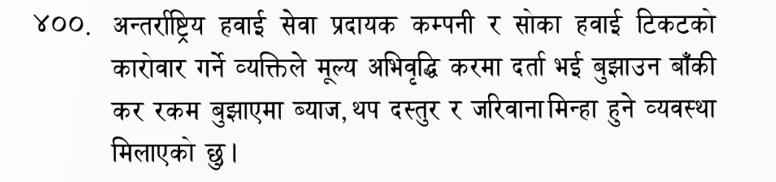
The Government of Nepal has announced a significant relief measure for international airline service providers and their ticketing agents operating in Nepal. As part of the Budget Statement for Fiscal Year 2082/83 (2025/26), the Ministry of Finance introduced an arrangement under Point No. 400 that offers a one-time waiver on interest, penalties, and additional fees associated with outstanding Value Added Tax (VAT) dues for international airline service providers and their ticketing agents operating in Nepal.

Key Points:

1).  Eligible Entities: International airlines and individuals/agents involved in the sale of international air tickets in Nepal.

2). Relief Offered: Full waiver on interest, additional fees, and penalties upon payment of the principal VAT due.

3). Conditions: Entities must be registered (or become registered) for VAT and settle dues within the timeframe prescribed by the Inland Revenue Department (IRD).

Explanation

The waiver arrangement allows eligible international airline service providers and ticketing agents that have unpaid VAT liabilities to regularize their tax status by paying only the outstanding principal amount. Once the principal is settled, the associated financial burdens of interest, late fees, and penalties will be fully waived, provided the taxpayer is registered under VAT and complies with the IRD prescribed procedures and timelines.

VAT Waiver Facility to International Airline
Relevant Provision Snippet

Disclaimer: This article is for general informational purposes only and does not constitute legal advice, advertisement, personal communication, solicitation or inducement. No attorney-client relationship is created through this content. Gandhi & Associates assumes no liability for any consequences resulting from actions taken based on information contained herein.

For quick legal assistance:

Phone/Viber/WhatsApp: +977 9709035477

For specific legal advice regarding VAT Waiver for International Airlines in Nepal, please contact our office to schedule a consultation with our experts.

Budget 2082/83 in Perspective of Business and Industries

1. Background and Strategic Importance

The Federal Budget of Nepal for Fiscal Year (F.Y.) 2082/83 introduces a wide array of economic reforms and legal adjustments aimed at revitalizing and restructuring Nepal’s industrial and commercial sectors. While the fiscal priorities focus on economic growth and private sector participation, businesses and industries must now pay closer attention to new legal responsibilities, investment structures, and compliance pathways.

This update outlines 18 key budget points that affect the industrial and business landscape, along with the legal implications and actions required to stay compliant and take advantage of opportunities.

2. Budget Highlights for Businesses and Industries

The following table summarizes major provisions from the budget along with the sectors impacted and relevant compliance pointers:

ProvisionImpacted SectorCompliance or Legal Concern
Foreign investment up to 25% of export income permittedExport-oriented industriesNRB guidelines, investment structuring, foreign exchange control
Recognition of Sweat Equity SharesStartups, IT, TechAmendment of AoA, share allotment compliance
Land ceiling relaxed for productive sectorsAgriculture, Housing, IndustrialLand Use Act compliance, documentation, cooperative land structuring
Legal reform in digital, IP, telecom sectorsIT, OTT platforms, broadcastingAnticipated new legislation, IP registration, content compliance
Criminal penalties for cooperative mismanagementCooperatives, Financial sectorsInternal audits, forensic assessments, potential litigation support
Nationwide expansion of consumer courtsFMCG, Retail, E-commerceConsumer rights compliance, dispute representation readiness
Zoning and EIA to proceed simultaneouslyInfrastructure, Hydropower, Real EstateIntegrated licensing, environmental law compliance
AI centers, data centers, and cybersecurity policy in pipelineTech, Data EconomyData governance frameworks, AI legal risk assessment
Tax exemptions for green and EV sectorsEnergy, Manufacturing, ImportCustoms and Excise Act compliance, environmental certifications
75% tax exemption on IT export incomeIT, BPO, Software ExportTax audit preparedness, export documentation integrity
Budget for PPP projects in transport, hydro, airportInfrastructure, ConstructionPDA contract reviews, concession negotiation, FDI structuring
Unified higher education lawEducation, Private CollegesStructural alignment, regulatory filings for academic institutions
Youth employment incentives and loansStartups, SMEsHR compliance, loan documentation, MoU with banks
Restructuring and mergers of cooperativesCooperative SocietiesDue diligence, merger contracts, liquidation guidance
OTT platform regulation proposedMedia, Streaming, DigitalLicensing frameworks, broadcast code adherence
Hotels and resorts classified as productive sectorTourism, HospitalityTax rebate applications, business classification adjustments
Rent waiver and relocation support for SEZ based industriesManufacturing, Export UnitsSEZ guidelines, lease agreements, relocation planning
Bioethanol, fuel blending, and green hydrogen projects supportedEnergy, Agri-techEnvironmental licensing, feasibility reports, tax benefits

3. Legal and Compliance Implications

Businesses must adjust internal structures and reporting frameworks to remain compliant and future-ready. Several of these provisions directly trigger legal compliance obligations including:

  1. Investment law compliance under the Foreign Investment and Technology Transfer Act (FITTA)
  2. Amendment to constitutional documents like MoA and AoA under the Companies Act
  3. Environmental and zoning approvals under the Environment Protection Act
  4. Consumer rights enforcement and contractual updates in commercial transactions
  5. IP, data, and media law alignment with forthcoming regulations.

4. Implementation and Industry Readiness

Based on recent government updates, many of the provisions from the budget are under active preparation for execution. This means that while not all laws are enacted, businesses are expected to:

  1. Evaluate their legal standing based on the budget’s sectoral reforms
  2. Prepare documentation and internal policies aligned with upcoming changes
  3. Engage proactively with authorities for classification updates, licensing, and exemptions
  4. Review existing contracts in areas like sweat equity, foreign investment, or green energy to ensure they reflect updated policy positions.

5. Immediate Action Points for Businesses

Businesses and industrial enterprises should consider taking the following actions in light of Budget 2082/83:

Action PointPurpose
Conduct legal assistance in light of budget reformsIdentify compliance gaps, missed exemptions
Update MoA, AoA or Shareholder AgreementsReflect sweat equity and sector-specific benefits
Consult on SEZ relocation or reclassificationUtilize rental waiver and subsidy support
Review investment and foreign funding plansAlign with NRB and IBN guidelines for 25% foreign investment
Prepare for EIA or project clearance integrationExpedite infrastructure project execution
Seek early registration for emerging sectorsHydrogen, biofuel, AI, and OTT to gain first-mover advantage

Note: This shall apply as applicable.

6. Consequences of Non-Compliance

Non-Compliance with the legal expectations emerging from Budget 2082/83 could lead to:

  1. Disqualification from tax exemptions and rent waivers
  2. Delay in project approvals or contract recognition
  3. Exposure to regulatory penalties and reputational risks
  4. Potential litigation in consumer or cooperative sectors

Disclaimer: This article is for general informational purposes only and does not constitute legal advice, advertisement, personal communication, solicitation or inducement. No attorney-client relationship is created through this content. Gandhi & Associates assumes no liability for any consequences resulting from actions taken based on information contained herein.

For quick legal assistance:

Phone/Viber/WhatsApp: +977 9709035477

For specific legal advice regarding Nepal’s Budget for FY 2082/83, please contact our office to schedule a consultation with our experts.

Sweat Equity in Nepal

I. Introduction

The Government of Nepal has formally recognized the concept of sweat equity as a landmark reform aimed at modernizing Nepal’s corporate legal framework. Through recent amendments to the Companies Act, 2063 (2006) (“Companies Act”), companies in Nepal are now permitted to issue shares not only for monetary investment but also in exchange for non-cash contributions such as intellectual property, technical expertise, services, goodwill, and know-how.

II. Concept of Sweat Equity

Sweat equity refers to shares issued by a company to its employees, promoters or directors in consideration for their non-monetary contributions, such as intellectual property rights, technical know-how, value additions, services rendered, or other tangible/intangible assets provided to the company. Unlike traditional equity that is acquired through monetary investment, sweat equity acknowledges the value of time, effort, expertise, and intellectual contributions made to a company’s growth and development.

III. Prior Legal Position: Restrictions on Non-Cash Share Issuance

Before the amendment, the Companies Act permitted the issuance of shares for non-cash consideration only at the time of incorporation, and such arrangements had to be reflected in the company’s Memorandum of Association (प्रबन्धपत्र).

Under Section 18(2) (a) of the Companies Act, promoters or other individuals could receive shares in exchange for property or assets contributed during incorporation with formal valuation by a certified engineer or auditor. However, the law did not allow companies to issue shares for services, goodwill, or intangible contributions after registration.

IV. The Amendment: Legal Recognition of Sweat Equity

The amendment to Section 18 of the Companies Act introduced several new provisions that establish a clear and flexible regime for issuing shares in exchange for non-cash contributions. The key additions are as follows:

1. Post-Incorporation Non-Cash Share Issuance (Section 18(3A))

Companies can issue or allot shares to promoters or other persons in exchange for non-cash consideration even after incorporation.

2. Special Resolution Requirement (Section 18(3B))

Such non-cash issuances or allotments must be approved by a special resolution at the company’s general meeting. The resolution can also authorize the issuance or sale of shares at a discount, granting companies flexibility to structure attractive offers for contributors.

3. Recognized Forms of Sweat Equity (Section 18(3C))

Shares can be issued in consideration for the various non-cash contributions including:

  1. Intellectual property,
  2. Value addition,
  3. Services rendered,
  4. Goodwill,
  5. Technical knowledge,
  6. Transfer of proprietary or technical know-how.

Valuation of such contributions must be conducted by a licensed engineer or auditor, and must provide a justified basis for the assigned value.

4. Share Compensation for Employees (Section 18(3D))

Where a written agreement exists between the company and an employee, the company can offer shares in lieu of salary, allowances, or other benefits, thereby facilitating equity-based employee compensation.

5. Limit on Non-Cash Issued Capital (Section 18(3E))

To ensure responsible dilution, the law caps sweat equity as follows:

  • For regular companies (other than those registered as startups), non-cash issued shares must not exceed 20% of the paid-up capital, and
  • For companies registered as startups, the threshold is raised to 40%.

6. Valuation Protocol (Section 18(4))

All non-cash contributions must be properly valued under prevailing laws. If no specific method is prescribed, the valuation professional must clearly state the basis of valuation, ensuring transparency and auditability.

7. Override Clause (Section 18(5))

If the company’s memorandum contradicts any of these new provisions, such conflicting provisions will be deemed void to the extent of inconsistency.

V. Conclusion:

The recognition of sweat equity marks a pivotal shift in Nepal’s corporate legal environment. It empowers startups to attract talent and strategic input without immediate financial outlay, allows companies to retain high-performing employees through equity-based incentives, and provides founders and investors with a structured mechanism for leveraging intangible contributions.

Disclaimer: This article is for general informational purposes only and does not constitute legal advice, advertisement, personal communication, solicitation or inducement. No attorney-client relationship is created through this content. Gandhi & Associates assumes no liability for any consequences resulting from actions taken based on information contained herein.

For quick legal assistance:

Phone/Viber/WhatsApp: +977 9709035477

For specific legal advice regarding sweat equity or structuring non-cash share arrangements in Nepal, please contact our office to schedule a consultation with our experts.

Legal Recognition and Regulation of Startup Enterprises in Nepal

A. Introduction

The Government of Nepal has recently introduced significant amendments to the Industrial Enterprise Act, 2076 (2020) (“Industrial Enterprise Act”) and the Industrial Enterprise Regulations, 2078 (2022) (“Industrial Enterprise Regulations”) ushering in a legal framework for the recognition, registration, and regulation of startup enterprises.

This article provides a detailed overview of the new provisions, the criteria for startup classification, the registration process, and the regulatory and promotional mechanisms established under the amended legal framework.

B. Definition of a Startup Enterprise

Pursuant to the Section 2(q1) and 4A of the Industrial Enterprise Act, a startup enterprise is defined as a firm or company that engages in the development, production, operation, or distribution of goods or services using innovative ideas or technologies. The classification is contingent upon the fulfillment of the following conditions:

S.N. Conditions
a)The entity must be registered as a new company, private firm, or partnership firm;
b)The enterprise must utilize innovative ideas and technologies in the production of goods or services;
c)The enterprise must exhibit potential for rapid growth or scalability;
d)The entity must not have surpassed ten years from the date of its initial registration;
e)The annual transaction of the enterprise must not exceed NPR 150 million in any fiscal year following its registration.

C. Procedure and Documents Required for Registration

The provision for registration and operation of start-up enterprise is provided in Chapter 2A of Industrial Enterprise Regulations.

The general procedure for registration of start-up enterprise is provided in the table below:

StepsProcedures
Step 1A firm or company seeking registration as a startup enterprise must submit an application to the industrial registration authority, along with the required document;
Step 2Upon review and verification, if the authority finds the applicant enterprise to be in compliance with the eligibility requirements, it will issue a Startup Enterprise Registration Certificate;

Step 3


The registering authority maintains a separate and integrated register of all certified startup enterprises;

Step 4


A registered startup must commence operations within one year from the date of registration and notify the authority accordingly.

The documents required for registration of start-up enterprise is provided in the table below:

S.N.Documents
a)      Copy of Nepalese citizenship certificate or passport (for foreign nationals);
b)     Firm registration certificate (for firms) or company registration certificate, Memorandum of Association, and Articles of Association (for companies);
c)      Letter of authorization if the application is submitted through a representative
d)     Foreign investment approval letter (if applicable)
e)      Copy of partnership agreement (if applicable)
f)       
  • For firms or companies already in operation, the annual audited financial report of the previous fiscal year;
  • For firms or companies not yet in operation, documentation evidencing financial status.
g)     A self-declaration regarding the use of innovative technologies or methodologies in the enterprise’s operations;

D. Grounds for Cancellation and Loss of Status

Rule 15B of the Industrial Enterprise Regulations provide for the cancellation of registration and the revocation of startup status. A startup enterprise will cease to retain its legal status as a startup under any of the following circumstances:

S.N. Conditions
a)Upon completion of ten years from the date of its initial registration;
b)If the enterprise’s annual turnover exceeds NPR 150 million in any fiscal year;
c)If its registration is voluntarily cancelled.

Note: The revocation of startup status does not affect the legal standing of the enterprise to continue operations as an industry under the prevailing laws.

E. Business Incubation Centre

The Government of Nepal, provincial government or local level can establish and operate a Business Incubation Centre in order to promote the startup enterprises or businesses pursuant to Section 4A of the Industrial Enterprise Act.

F. Conclusion;

The amendments to the Industrial Enterprise Act and Industrial Enterprise Regulations signify a landmark development in Nepal’s industrial and entrepreneurial landscape. By formally recognizing startup enterprises as a distinct category of industrial entities, the legislation establishes a comprehensive legal and policy framework to support their growth and sustainability.

Disclaimer: This article is for general informational purposes only and does not constitute legal advice, advertisement, personal communication, solicitation or inducement. No attorney-client relationship is created through this content. Gandhi & Associates assumes no liability for any consequences resulting from actions taken based on information contained herein.

For quick legal assistance:

Phone/Viber/WhatsApp: +977 9709035477

For specific legal advice regarding registration of start-up enterprise in Nepal, please contact our office to schedule a consultation with our experts.