Legal Recognition and Regulation of Startup Enterprises in Nepal

A. Introduction

The Government of Nepal has recently introduced significant amendments to the Industrial Enterprise Act, 2076 (2020) (“Industrial Enterprise Act”) and the Industrial Enterprise Regulations, 2078 (2022) (“Industrial Enterprise Regulations”) ushering in a legal framework for the recognition, registration, and regulation of startup enterprises.

This article provides a detailed overview of the new provisions, the criteria for startup classification, the registration process, and the regulatory and promotional mechanisms established under the amended legal framework.

B. Definition of a Startup Enterprise

Pursuant to the Section 2(q1) and 4A of the Industrial Enterprise Act, a startup enterprise is defined as a firm or company that engages in the development, production, operation, or distribution of goods or services using innovative ideas or technologies. The classification is contingent upon the fulfillment of the following conditions:

S.N. Conditions
a)The entity must be registered as a new company, private firm, or partnership firm;
b)The enterprise must utilize innovative ideas and technologies in the production of goods or services;
c)The enterprise must exhibit potential for rapid growth or scalability;
d)The entity must not have surpassed ten years from the date of its initial registration;
e)The annual transaction of the enterprise must not exceed NPR 150 million in any fiscal year following its registration.

C. Procedure and Documents Required for Registration

The provision for registration and operation of start-up enterprise is provided in Chapter 2A of Industrial Enterprise Regulations.

The general procedure for registration of start-up enterprise is provided in the table below:

StepsProcedures
Step 1A firm or company seeking registration as a startup enterprise must submit an application to the industrial registration authority, along with the required document;
Step 2Upon review and verification, if the authority finds the applicant enterprise to be in compliance with the eligibility requirements, it will issue a Startup Enterprise Registration Certificate;

Step 3


The registering authority maintains a separate and integrated register of all certified startup enterprises;

Step 4


A registered startup must commence operations within one year from the date of registration and notify the authority accordingly.

The documents required for registration of start-up enterprise is provided in the table below:

S.N.Documents
a)      Copy of Nepalese citizenship certificate or passport (for foreign nationals);
b)     Firm registration certificate (for firms) or company registration certificate, Memorandum of Association, and Articles of Association (for companies);
c)      Letter of authorization if the application is submitted through a representative
d)     Foreign investment approval letter (if applicable)
e)      Copy of partnership agreement (if applicable)
f)       
  • For firms or companies already in operation, the annual audited financial report of the previous fiscal year;
  • For firms or companies not yet in operation, documentation evidencing financial status.
g)     A self-declaration regarding the use of innovative technologies or methodologies in the enterprise’s operations;

D. Grounds for Cancellation and Loss of Status

Rule 15B of the Industrial Enterprise Regulations provide for the cancellation of registration and the revocation of startup status. A startup enterprise will cease to retain its legal status as a startup under any of the following circumstances:

S.N. Conditions
a)Upon completion of ten years from the date of its initial registration;
b)If the enterprise’s annual turnover exceeds NPR 150 million in any fiscal year;
c)If its registration is voluntarily cancelled.

Note: The revocation of startup status does not affect the legal standing of the enterprise to continue operations as an industry under the prevailing laws.

E. Business Incubation Centre

The Government of Nepal, provincial government or local level can establish and operate a Business Incubation Centre in order to promote the startup enterprises or businesses pursuant to Section 4A of the Industrial Enterprise Act.

F. Conclusion;

The amendments to the Industrial Enterprise Act and Industrial Enterprise Regulations signify a landmark development in Nepal’s industrial and entrepreneurial landscape. By formally recognizing startup enterprises as a distinct category of industrial entities, the legislation establishes a comprehensive legal and policy framework to support their growth and sustainability.

Disclaimer: This article is for general informational purposes only and does not constitute legal advice, advertisement, personal communication, solicitation or inducement. No attorney-client relationship is created through this content. Gandhi & Associates assumes no liability for any consequences resulting from actions taken based on information contained herein.

For quick legal assistance:

Phone/Viber/WhatsApp: +977 9709035477

For specific legal advice regarding registration of start-up enterprise in Nepal, please contact our office to schedule a consultation with our experts.

Nepal Introduces Free Visas for Non-Resident Nepalis (NRNs)

The Government of Nepal has introduced significant amendments to the Non-Resident Nepali Act, 2064 (2008) (“NRN Act”), aimed at enhancing the legal rights and privileges of Non-Resident Nepalis (NRNs). These changes were brought into effect on 18 Chaitra 2081 (31 March 2025) through the enactment of the Act Amending Various Acts Relating to the Promotion of Good Governance and Delivery of Public Services, 2081 (2025).

The key highlights of the amendment are provided below:

1. Expanded Definition of NRNs

The amended legislation broadens the scope of who qualifies as a NRN. The updated definition now includes the following categories:

  1. Person holding NRN citizenship;
  2. Foreign citizens of Nepalese origin; and
  3. Nepalese citizens residing abroad.

Previously, the NRN definition only included:

  1. A foreign citizen of Nepalese origin; and
  2. A Nepalese citizen residing abroad.

The revised definition ensures a more inclusive recognition of individuals connected to Nepal, whether through citizenship, heritage, or foreign residency.

2. Free Visa Privileges for NRNs

The amendment to Section 11 of the NRN Act introduces a major incentive in the form of free visas for eligible NRNs and their families. The key provisions are:

a) Free NRN Visas for up to 10 Years:

Individuals residing in Nepal who hold NRN citizenship, foreign citizen of Nepalese origin with NRN ID card, and their family members will be entitled to a non-residential visa free of charge for up to ten years.

b) Multi-entry Residential Visa (Free of Cost):

A person who has obtained NRN citizenship will be granted a multi-entry residential visa valid for two years per issuance, free of charge.

These developments represent a proactive step by the Nepal Government to strengthen ties with the global Nepali diaspora and incentivize continued engagement with Nepal.

Overview of Food Hygiene and Quality Act, 2081 (2024)

Nepal’s regulatory landscape for food safety has entered a new phase with the enactment of the Food Hygiene and Quality, 2081 (2024) (“Food Hygiene and Quality Act”). Replacing the long-standing Food Act, 2023 (1967), the Food Hygiene and Quality Act reflects Nepal’s efforts to modernize its food safety framework and align domestic practices with international standards.

This article provides the general overview of the key provisions, procedures, and compliance requirements under the Food Hygiene and Quality Act.

A. Definition of Food, and Regulation of Food Hygiene & Quality

Food Hygiene and Quality Act defines food as any unprocessed, semi-processed or processed food or beverage commonly consumed by humans, any nutritional ingredient, food additive or condiment (Marmasala) used therein, and the term also includes dietary supplements, packaged purified drinking water, alcoholic beverages, chewing gum and bubblegum.

The Government of Nepal can, time to time, determine the food quality by publishing a notification in Nepal Gazette. The provincial and local level government also has the power to regulate the food hygiene and quality within its province and local level.

B. Approval for registration of food industry

Any person willing to operate a food industry in Nepal must first obtain a recommendation letter from the Department of Food Technology and Quality Control (“DFTQC) (or its prescribed office) and then secure an approval letter from the concerned local authority or the DFTQC, depending on the type of business.

A step-by-step procedure for obtaining approval for food business registration is provided below:

Step 1: Obtain a Recommendation Letter from the DFTQC or prescribed office

To start a food industry, such like production, processing, packaging, or storage, a person must obtain a recommendation letter from DFTQC or the relevant office. If the industry is registered under a provincial government, a person must obtain a recommendation from the provincial food hygiene office (if such office exist).

Step 2: Submit Necessary Documents for Recommendation

The following documents must be submitted along with the application for obtaining a recommendation letter, details of which are as follows:

S.N.

Required Documents


1.A letter from the industry registration office requesting a recommendation.
2.Details about the industry (capital amount, production capacity).
3.Technical proposal regarding the process to maintain food hygiene and quality of the food items to be produced and processed, and details of the related human resource.

Step 3: Inspection and Issuance of Recommendation

Upon reviewing the submitted documents and conducting necessary inspections, if the proposed food industry is found capable of maintaining hygiene and quality standards, the DFTQC or prescribed office issues a recommendation letter upon payment of the prescribed fee.

Step 4: Obtain Approval Letter

Prior to commencing operations, the food industry must obtain an approval letter, details of which are as follows:

  1. For local businesses (such as hotels, restaurants, catering services, retail and wholesale food vendors, and street vendors), the approval must be obtained from the Chief of the local level authority or their prescribed official.
  2. For businesses involved in food import, export, or other activities not falling under the local authority, the approval must be obtained from the Director General of the DFTQC or the head of the prescribed office.

Step 5: Submit Necessary Documents for Approval Letter

The following documents must be submitted along with the application for obtaining an approval letter, details of which are as follows:

S.N.

Required Documents


1.A copy of the food business registration certificate.
2.Information regarding the types and estimated annual quantities of food products to be handled.
3.Detailed descriptions of the technologies and procedures to be used for ensuring hygiene and quality during production, processing, packaging, and storage.
4.Business address, contact information, and details of key personnel involved in the management.

Step 6: Inspection and Issuance of Approval Letter

The approving authority conducts site inspections and laboratory testing, as necessary. If satisfied that the applicant can maintain the required standards, the authority will issue the approval letter within thirty (30) days, specifying any conditions that must be followed during the operation of the food business.

C. Validity Period and Renewal of Approval Letter

Validity Period:

The approval letter issued for operating a food business remains valid for a period of two (2) years from the date of issuance.

Application for Renewal:

Food business operators must apply for the renewal of their approval letter at least thirty-five (35) days before its expiration. The renewal application must be submitted to the same authority that issued the original approval letter, along with the required documents.

D. Suspension and Revocation of Approval Letter

The grounds for suspension and revocation of approval letter is described in the table below:

S.N.Grounds for SuspensionGrounds for Revocation
1In case of failure to comply with orders issued during inspections regarding food hygiene and quality within the given deadline, the approval will be suspended until compliance is achieved.If the food business operator voluntarily submits an application requesting the cancellation of their approval letter.
2In case a legally authorized official or institution recommends suspension in writing, the approval may be suspended for a maximum of three (3) months.If the registration of the food business is no longer valid or has been cancelled according to the prevailing laws.
3In case the minimum standards of food hygiene and quality, as required under the law, are not maintained, the approval may be suspended until compliance.
4In case of failure to renew the approval letter as required by law, suspension will remain in effect until renewal is completed.

Note: If the suspension is due to failure to renew the approval and the permitted time for renewal has already expired, the food business operator must pay five (5) times the standard renewal fee to renew the approval to lift the suspension.

E. Import and Export of Food Products

a. Import Approval

Food business operators intending to import food products must obtain prior approval from the DFTQC (or prescribed office) before proceeding with the import.

b. Quality Certification for Export

Food business operators who wish to export food products can request the DFTQC (or prescribed office) to certify whether the products meet the quality standards of the destination country.

F. Prohibited Activities

Chapter 4 of the Food Hygiene and Quality Act provides for the prohibited activities in relation to food production, packaging, sale, and distribution, details of which are as follows:

  1. Selling or distributing contaminated food products.
  2. Selling or distributing food products in a deceptive manner.
  3. Using more than the permitted amount of food additives and processing aids.
  4. Producing, selling, or distributing food products without proper labeling.

G. Monitoring and Inspection

Chapter 5 of the Food Hygiene and Quality Act provides the framework for monitoring, inspection, to ensure compliance with food safety standards. The key provisions are:

S.N.Monitoring and InspectionDetails
1InspectionThe DFTQC or Ministry of Agriculture and Livestock Development can conduct or initiate high-level investigations if activities contrary to food hygiene, quality, or management systems cause or may cause significant public harm. The DFTQC, its offices, or food inspection officers may also undertake unannounced inspections of food businesses.
2Sample Collection and TestingAuthorized officers can collect food samples from the market when there is suspicion of non-compliance with quality standards. Samples are tested in laboratories, and if found unsafe or substandard, appropriate action and public disclosure shall follow.
3Restriction OrderUpon reasonable suspicion of non-compliance, authorized officers may, with prior approval, order the restriction or removal of food products from sale.
4Compliance OrderIf food businesses fail to meet legal obligations, monitoring officers can issue written orders specifying a time frame for compliance.

Note: Provincial and local authorities can appoint food inspectors to conduct monitoring and inspections within their jurisdictions.

H. Offence and Punishment

S.N.OffencePunishment
1a) Operating a food business without obtaining an approval letter;
b) Undertaking activities resulting in suspension of the approval letter;
c) Importing food without obtaining approval or entry permit prior to importation;
d) Failure of producers, processors, packagers, importers, transporters, sellers, or service providers to fulfill obligations or acting contrary to the Food Hygiene and Quality Act;
e) Undertaking any other activities prohibited by the Food Hygiene and Quality Act.
Fine up to fifty thousand rupees (NPR 50,000)
2Producing, processing, exporting, importing, storing, transporting, selling, distributing or putting up for sale contaminated food that is:
• Rotten, contaminated with garbage, or toxic;
• Made of diseased or pathogenic animal/plant material;
• Containing natural/artificial toxins, hormones, or psychotropic chemicals;
• Containing radiation exceeding prescribed limits;
• Using prohibited substances or materials under prevailing laws.
• Imprisonment up to five (5) years; or
• Fine up to five lakhs (NPR 5,00,000); or
• Both.
3Producing, processing, exporting, importing, storing, transporting, selling, distributing or putting up for sale contaminated food:
• Containing pathogenic microorganisms, harmful substances or chemicals exceeding prescribed limits;
• Containing chemical residues (pesticides, veterinary drugs, bacterial toxins) exceeding prescribed limits.
• Imprisonment up to one (1) year; or
• Fine up to four lakhs (NPR 4,00,000); or
• Both.
4a) Producing, processing, exporting, importing, storing, transporting, selling or distributing food of substandard quality;
b) Producing, processing, exporting, importing, storing, transporting, selling or distributing food by deception or misrepresentation;
c) Using more than the permitted amount of food additives or food processing aids.
• Imprisonment up to six (6) months; or
• Fine up to three lakhs (NPR 3,00,000); or
• Both.
5Selling or distributing food without labeling, or labeling food contrary to prevailing laws.Fine up to one lakh (NPR 1,00,000)
6a) Selling or distributing a food product that has been ordered to be removed from sale;
b) Failure to comply with an order from an inspection or monitoring officer;
c) Selling or distributing a food product in contravention of a recall order.
Fine up to three lakhs (NPR 3,00,000)

I. Conclusion

Food Hygiene and Quality Act represents a significant advancement in Nepal’s approach to regulating food safety and quality. By establishing clearer standards, modern procedures, and stronger enforcement mechanisms, the Act aims to protect public health and build greater confidence in the food sector.

Disclaimer: This article is for general informational purposes only and does not constitute legal advice, advertisement, personal communication, solicitation or inducement. No attorney-client relationship is created through this content. Gandhi & Associates assumes no liability for any consequences resulting from actions taken based on information contained herein.

For quick legal assistance:

Phone/Viber/WhatsApp: +977 9709035477

For specific legal advice regarding food business registration at DFTQC or local level in Nepal, please contact our office to schedule a consultation with our experts.

Court Marriage in Nepal For Nepali Citizens

Court marriage, also referred to as paper marriage, is an increasingly popular legal route for couples in Nepal, including both Nepali citizens and foreign nationals. The matters relating to court marriage in Nepal is governed by the National Civil (Code) Act, 2074 (2017).

This article outlines the legal basis, procedural steps, required documents, and special considerations for both domestic applicants for court marriage in Nepal.

A. Legal Basis

National Civil (Code) Act, 2074 (2017) law permits individuals to register their marriage either through:

  • Court marriage, which involves applying directly to the District Court; or
  • Social/religious marriage registration, which involves registering a marriage conducted through cultural or religious rituals at the local level ward office.

Although the law also allows for registration at a Nepalese Embassy or Consulate, this practice is not yet widely adopted.

B. Eligibility Criteria

To be eligible for court marriage, both parties must:

  1. Be at least 20 years old;
  2. Be unmarried at the time of registration (or legally divorced); and
  3. Mutually agree to enter into marriage.

C. Step-by-Step Registration Process

The court marriage process is relatively straightforward but requires precise documentation and physical presence of both applicants.

A step-by-step procedure for registration of court marriage in Nepal is provided below:

S.N.Procedure
 
1.Obtain Single Status Certificate from each applicant’s ward office.
2.Apply at the District Court, submitting all required documents.
3.The court examines the documents and may seek clarification if needed.
4.Upon satisfaction, the court grants the marriage certificate.
5.Both parties and two witnesses must be physically present on the day of certificate issuance.

D. Required Documents and Timeline

The documents required for completion of court marriage procedure are as follows:

S.N. DocumentNotes
1.Citizenship certificates (notarized)For both parties
2.Single status letterIssued by Ward Office
3.Witness citizenship (notarized)One from each party
4.Temporary residence letterIf applying in a different district
5.Passport-size photos4 each
6.Divorce decreeIf applicable

Timeline: 2-3 working days.

E. Legal Validity and International Recognition

A marriage certificate issued through a court marriage in Nepal is legally binding and recognised for all civil and administrative purposes within Nepal.

F. Fees and Charges

ServiceFee (NPR)
Single Status CertificateVaries by municipality
Temporary Residence Certificate (Nepali)NPR 2,000
Court RegistrationNPR 500

Final Thoughts

Court marriage provides Nepali citizens with a straightforward and legally recognized way to formalize their unions without extensive rituals. By preparing proper documentation and understanding the process, couples can efficiently navigate court marriage registration.

Disclaimer: This article is for general informational purposes only and does not constitute legal advice, advertisement, personal communication, solicitation or inducement. No attorney-client relationship is created through this content. Gandhi & Associates assumes no liability for any consequences resulting from actions taken based on information contained herein.

For quick legal assistance:

Phone/Viber/WhatsApp: +977 9709035477

For specific legal advice regarding Court Marriage and procedural compliance in Nepal, please contact our office to schedule a consultation with our experts.

Court Marriage in Nepal For Foreigners

Court marriage, also referred to as paper marriage, is an increasingly popular legal route for couples in Nepal, including both Nepali citizens and foreign nationals. The matters relating to court marriage in Nepal is governed by the National Civil (Code) Act, 2074 (2017).

This article outlines the legal basis, procedural steps, required documents, and special considerations for international applicants for court marriage in Nepal.

A. Legal Basis

National Civil (Code) Act, 2074 (2017) law permits individuals to register their marriage either through:

  • Court marriage, which involves applying directly to the District Court; or
  • Social/religious marriage registration, which involves registering a marriage conducted through cultural or religious rituals at the local level ward office.

Although the law also allows for registration at a Nepalese Embassy or Consulate, this practice is not yet widely adopted.

B. Eligibility Criteria for Court Marriage (Involving a foreigner)

To be eligible for court marriage, both parties must:

  1. Be at least 20 years old;
  2. Be unmarried at the time of registration (or legally divorced); and
  3. Mutually agree to enter into marriage.

In addition to the above, the foreign citizen must:

  1. Have stayed in Nepal for at least 15 continuous days;
  2. Obtain and present a Single Status Certificate from their Embassy or relevant government authority in their home country;
  3. Provide a notarized English translation of their country’s marriage laws.

C. Step-by-Step Registration Process

The court marriage process is relatively straightforward but requires precise documentation and physical presence of both applicants.

A step-by-step procedure for registration of court marriage involving foreigner in Nepal is provided below:

S.N.Procedure
1Obtain Single Status Certificate;
2Apply at the District Court, submitting all required documents;
3The court examines the documents and may seek clarification if needed;
4Upon satisfaction, the court grants the marriage certificate;
5Both parties and two witnesses must be physically present on the day of certificate issuance.

D. Required Documents and Timeline

The documents required for completion of court marriage procedure involving a foreigner in Nepal are as follows:

S.N.DocumentApplicable to
1Citizenship certificates (notarized)Nepali citizen
2Passport copy with valid visaForeigner
3Single status letter issued by local level ward office in case of Nepali, and issued by Embassy or home country in case of foreignerBoth Nepali and foreigner
4Witness citizenship (notarized): One from each partyBoth Nepali and foreigner
5Temporary residence (15 days) letter issued by ward officeBoth Nepali (if applying from different district) and foreigner
6Passport-size photosBoth Nepali and foreigner
7Divorce decree, if applicableBoth Nepali and foreigner
8Notarized foreign marriage law in English languageForeigner

Timeline: Approximately 19 to 22 working days (buffer included for document clarifications).

E. Legal Validity and International Recognition

A marriage certificate issued through a court marriage in Nepal is legally binding and recognised for all civil and administrative purposes within Nepal.

For international recognition, especially if either spouse is a foreign national or intends to use the certificate abroad:

  1. Notarise the certificate at the Department of National Personal Records (Rastriya Kitabkhana).
  2. Attest the notarised certificate at the Ministry of Foreign Affairs of Nepal.

These steps enhance the credibility of the document for visa, immigration, and family law procedures internationally.

F. Fees and Charges

ServiceFee (NPR)
Single Status CertificateVaries by municipality
Temporary Residence Certificate (Nepali)NPR 2,000
Temporary Residence Certificate (Foreigner)NPR 10,000
Court RegistrationNPR 500

Final Thoughts

Court marriage in Nepal is a legally efficient and flexible option for couples seeking formal recognition of their union, whether they are both Nepali citizens or involve a foreign partner. However, navigating the legal system and ensuring documentation is accurate requires careful attention.

Disclaimer: This article is for general informational purposes only and does not constitute legal advice, advertisement, personal communication, solicitation or inducement. No attorney-client relationship is created through this content. Gandhi & Associates assumes no liability for any consequences resulting from actions taken based on information contained herein.

For quick legal assistance:

Phone/Viber/WhatsApp: +977 9709035477

For specific legal advice regarding Court Marriage and procedural compliance in Nepal, please contact our office to schedule a consultation with our experts.

NRN Citizenship in Nepal

Introduction

The Government of Nepal through the third amendment to the Nepal Citizenship Act, 2006 (2063) (“Nepal Citizenship Act”), has introduced a special provision allowing Non-Resident Nepalis (NRNs) to obtain Non Resident Nepali (NRN) Citizenship—a unique legal status that bridges the gap between foreign citizenship and Nepalese heritage.

The NRN citizenship enables NRNs to enjoy economic, social, and cultural rights in Nepal, while expressly excluding political rights such as voting or holding public office. As per the amendment, any person who has acquired foreign citizenship (excluding SAARC countries) after being a citizen of Nepal by descent or birth—either through their parents or grandparents—is entitled to enjoy economic, social, and cultural rights in Nepal through NRN citizenship.

Legal Framework and Eligibility Criteria

The NRN citizenship is governed by Section 7A of the Nepal Citizenship Act and corresponding regulations. The law outlines both the eligibility requirements and procedural obligations.

To qualify, an applicant must:

  • Have a parent or grandparent who was a Nepalese citizen.
  • Possess foreign citizenship (other than from a SAARC member country).
  • Provide proof of renunciation of Nepalese citizenship, if previously held.
  • Submit a declaration of commitment to adhere to Nepal’s Constitution and laws.
  • Provide supporting documentation verifying current foreign citizenship and residence.

Where a person had previously obtained Nepalese citizenship and failed to submit their original certificate during renunciation, that document must be furnished at the time of applying for NRN citizenship.

Step-by-Step Process for Obtaining NRN Citizenship

Eligible individuals may apply for NRN citizenship through two channels:

A. Direct Application at District Administration Office (DAO):

  • The applicant may also personally apply at the DAO in Nepal. This method is often quicker and more reliable in practice.

Once the application is received:

  • The DAO may request proof of prior renunciation of Nepalese citizenship (if not already submitted).
  • Two close relatives (or any Nepalese citizens familiar with the applicant) must appear for identity verification.
  • The applicant must take an oath affirming allegiance to Nepal’s Constitution and legal system.
  • Upon successful verification, the DAO grants the NRN Citizenship Certificate.
  • Practical Consideration:
    • Several DAO offices require recommendation letters from the applicant’s local Ward Office as additional verification of ancestral origin.
    • The CDO may request police verification if there is any doubt about the legitimacy or accuracy of the documents submitted.

B. Through the Embassy or Consulate (Abroad)

  • Submit an application at the Nepalese Embassy or Consulate in the foreign country of residence.
  • The diplomatic mission forwards the application to the Ministry of Foreign Affairs, which then transmits it to the concerned DAO in Nepal for verification and issuance.
  • Practical Consideration:
    • Despite the legal provision to apply via diplomatic channels, most Nepali embassies and consulates currently advise applicants to apply directly in Nepal at the relevant DAO.

 Estimated Timeline

Applicants applying directly at the concerned DAO in Nepal can expect the full process—from submission to issuance of the certificate—to take approximately 10 to 12 working days, provided all documentation is in order.

Required Documentation

A. To Renounce Nepalese Citizenship (If not renounced)

  • Original Nepalese citizenship certificate and passport.
  • Copy of the foreign passport.
  • Citizenship or identity proof of a parent or close relative or witness for verification.

B. To Obtain NRN Citizenship

  • Recommendation letter from the concerned Ward Office verifying the ancestral connection.
  • Commitment letter to abide by Nepalese law (format available at the DAO).
  • Certificate showing renunciation of former Nepalese citizenship (if applicable).
  • Copy of foreign citizenship certificate or passport.
  • Proof of foreign residence (utility bill, tenancy contract, etc.).
  • Two close relatives or known Nepali individuals to verify applicant identity.
  • Evidence that father, mother, grandfather, or grandmother was a Nepalese citizen before acquiring foreign citizenship.

Additional Legal and Procedural Insights

a. Embassy Applications

Although legally viable, embassy-based applications are currently not preferred and recommended due to delays and procedural uncertainty. In most cases, applicants are redirected to Nepal.

b. Exclusion of SAARC Nationals

Persons who have acquired citizenship from any SAARC member country are explicitly excluded from eligibility.

c. No Dual Citizenship

NRN Citizenship is a special, non-political citizenship. It does not equate to dual citizenship and does not permit:

  • Voting rights
  • Holding public office
  • Acquiring a Nepalese passport

d. Grounds for Cancellation

NRN citizenship can be revoked under specific circumstances, including:

  • Submission of false informationduring the application process.
  • Engagement in activities that threaten Nepal’s sovereignty, national interest, or territorial integrity.
  • Violation of Nepalese laws that disqualify an individual from enjoying NRN status.

e. Reacquisition of Full Nepalese Citizenship

Former Nepalese citizens who wish to regain full citizenship can do so under Section 11 of the Nepal Citizenship Act, by formally renouncing their foreign citizenship and applying to the relevant DAO.

f. Validity and Use

Once issued, the NRN citizenship certificate remains valid indefinitely, provided there are no disqualifying changes in status. It is advisable to retain multiple certified copies and notify local authorities in Nepal when engaging in property or business transactions.

Disclaimer: This article is for general informational purposes only and does not constitute legal advice, advertisement, personal communication, solicitation or inducement. No attorney-client relationship is created through this content. Gandhi & Associates assumes no liability for any consequences resulting from actions taken based on information contained herein.

For quick legal assistance:

Phone/Viber/WhatsApp: +977 9709035477

For specific legal advice regarding NRN citizenship and procedural compliance, please contact our office to schedule a consultation with our experts.

Industry Update and Compliance Requirements

This update aims to inform about the key developments in Nepal’s industrial regulatory framework that may affect the industrial compliance obligations.

1. Background on Industry Registration

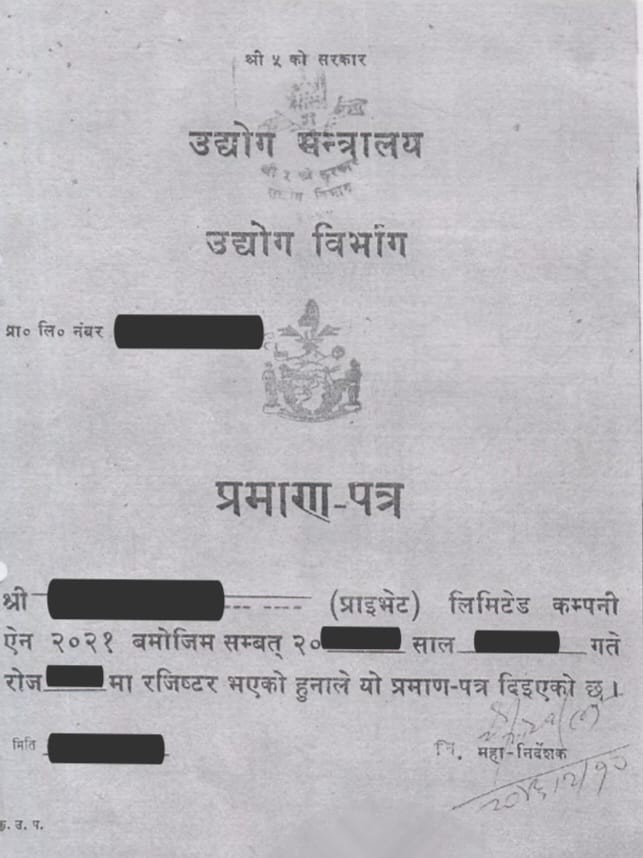
Under the Industrial Enterprises Act, 2038 (1981), all industries in Nepal, regardless of their capital structure, were required to register with the Department of Industry (DOI). For reference, a sample of such a registration certificate is provided below.

Gandhi & Associates Industry Updates and Compliance Requirements

This centralized system remained in place until the enactment of the Industrial Enterprises Act, 2049 (1992), which introduced a new classification of industries based on fixed capital investment.

2. Current Legal Framework and Classification

At present, the regulatory landscape is governed by:

  • Industrial Enterprises Act, 2076 (2020)
  • Industrial Enterprises Regulations, 2078 (2021)

These laws define industry categories and assign oversight as follows:

CategoryFixed CapitalRegulatory Authority
Cottage and SmallUp to NPR 150 millionDepartment of Cottage and Small Industries (DOCSI)
MediumNPR 150 million – NPR 500 millionDepartment of Industry (DOI)
LargeAbove NPR 500 millionDepartment of Industry (DOI)

3. New Compliance Requirements

Under the current framework, all industries are now required to:

  • Submit annual reports within six (6) months of end of each fiscal year to their respective authority, and
  • Obtain an Industry Update Letter confirming their operational status.
  • This requirement is mandatory, regardless of when and where the industry was originally registered.

4. Recent Implementation

From the latest fiscal year, the DOI and DOCSI have actively begun accepting annual reports and issuing either:

  • An Updated Industrial Registration Certificate, or
  • An Industry Update Letter, depending on the case.

This reflects the full implementation of the update process outlined in the Industrial Enterprises Act, 2076 (2020) and Regulations, 2078 (2021).

5. Why is immediate action required?

Failure to comply with the new requirements may result in fines as set out in the Industrial Enterprises Act, 2076 (2020). To avoid such risks, we strongly advise that industries—especially those previously registered with the DOI—submit the necessary documents and apply for the Industry Update Letter without delay.

Please note that while this step is not to guarantee the immediate issuance of the Updated Industry Registration Certificate or Industry Update Letter; or to waive any fines already accrued, it is a proactive measure that can help avoid further fines for non-compliance under the current framework.

If you need any assistance with preparing the documents or determining your correct industry classification, our team is available to guide you through the process.

Nepal Mandates Enlistment/Registration for Social Media Platforms

10 April 2025

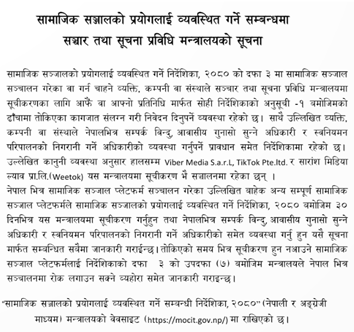
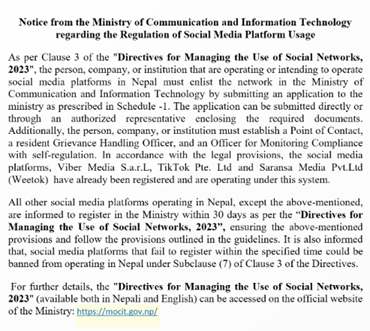
The Ministry of Communication and Information Technology (“Ministry”) under Government of Nepal has issued a notice on 25 March 2025 (12 Chaitra 2081) requiring all social media platforms operating in Nepal to register with the Ministry within 30 days (i.e., by 24 April 2025).

Key Points:

  1. All the social media platforms operating in Nepal must submit an application for enlistment pursuant to the Directives for Managing the Use of Social Media, 2023 (2080) (“Social Media Directives”);
  2. Platforms such as Viber Media S.a.r.l., TikTok Pte. Ltd., and Saransa Media Lab Pvt. Ltd. (Weetok) have already completed registration and are currently operating in compliance with these requirements;
  3. Platforms must establish three positions in Nepal: a Point of Contact, a resident Grievance Handling Officer, and an Officer for Monitoring Compliance;
  4. Platforms failing to register by the deadline may be banned from operating in Nepal pursuant to Section 3(7) of the Social Media Directives.

The full text of notice (both in Nepali and English language) published by the Ministry can be accessed from here.

Liquidation of Companies in Nepal

A. Introduction

Liquidation refers to the formal process of dissolving a company by selling its assets, paying off creditors, and distributing any remaining proceeds to shareholders, effectively bringing a company’s existence to an end. In Nepal, there are two types of liquidation, which includes:

  1. Voluntary Liquidation as per Companies Act; and
  2. Compulsory Liquidation as per Insolvency Act.

This article provides a general overview of the liquidation processes in Nepal.

B. Governing Laws

  1. Companies Act, 2006 (“Companies Act”) deals with voluntary liquidation process;
  2. Insolvency Act, 2006 (“Insolvency Act”) deals with compulsory liquidation/insolvency process.

Note: The liquidation process for banks and financial institutions is governed by Bank and Financial Institutions Act, 2017; and for insurance companies is governed by Insurance Act, 2022. This article does not cover the liquidation process of such specific sectors.

C. Voluntary Liquidation

A voluntary liquidation is the process where a company’s shareholders willingly decide to dissolve the company by passing a special resolution, and appointing a liquidator to settle debts and distribute remaining assets. Chapter 10 of the Companies Act deals with the provisions relating to voluntary liquidation.

1. Conditions of Voluntary Liquidation

A company can undergo voluntary liquidation process in the conditions as follows:

S.N.Conditions
1.If the company is able to pay its debts or other liabilities fully;
2.If the company has not initiated insolvency proceeding or there is no possibility of the same;
3.If the board of directors has acknowledged in writing that the company is in financial position to pay its debts and liabilities or declared that such liabilities can be settled within a year from the date of the decision to liquidate the company.
4.If such written declaration was presented in the general meeting called to discuss the matter of liquidation of the company or such declaration was made at the time of discussions on that matter in the general meeting.

2. Procedure of voluntary liquidation

A step-by-step procedure for voluntary liquidation of a company is provided in the table below:

StepsProcedure
Step 1Company must internally verify its financial statements to establish the position to pay all its debts and liabilities;
Step 2The shareholder of the company must pass a written resolution from the General Meeting and submit an application to Office of the Company Registrar (“OCR”);
Step 3The company must appoint the liquidator and auditor from the General Meeting and inform the concerned government authorities such as, OCR, and Inland Revenue Department (“IRD”) within seven (7) days of the appointment;
Step 4If such written declaration was presented in the general meeting called to discuss the matter of liquidation of the company or such declaration was made at the time of discussions on that matter in the general meeting;
Step 5Liquidator recovers and discharges the debts and other liabilities pursuant to the power and duties provided under the Companies Act;
Step 6Submission of report prepared by the liquidator at the OCR;
Step 7Upon review of the report and application, the OCR approves the company liquidation process, and removes the company’s name from its record book.

D. Compulsory Liquidation/Insolvency

Compulsory liquidation/Insolvency in Nepal is a court-ordered process that forces a company to close when it cannot pay its debts, initiated through a petition by creditors or regulatory authorities and overseen by a court-appointed liquidator who takes control of all company affairs.

Compulsory liquidation/Insolvency proceeding is subject to the provisions of the Insolvency Act.

a. Application for insolvency proceeding

Pursuant to the Insolvency Act, the insolvency proceeding against a company commences once an application is filed at the High Court by any concerned parties, details of which are follows:

S. N.Procedure
AA company itself which has become insolvent;
BCreditors with at least 10% of credit in the company;
CShareholders who have subscribed to at least 5% of the total shares of the company;
DDebenture holders who have subscribed to at least 55% of debenture out of the total debenture;
EA liquidator who has been appointed to liquidate a company;
FRegulating government authority for any specific type of business.
b. Process of Compulsory Liquidation in Nepal

A step-by-step procedure for compulsory liquidation of a company is provided in the table below:

StepsProcedure
Step 1Submission of liquidation application to the concerned High Court;
Step 2Order of the court whether or not to initiate the insolvency process;
Step 3Appointment of an investigating officer by the court to inquire about the financial status or the possibility of restructuring;
Step 4The investigating officer shall prepare a report after investigation, and call for the creditor’s meeting to discuss regarding the financial position of the company before submission of the final report before the court;
Step 5After the submission of the report, the court gives order either to liquidate the company, or undergo restructuring procedure;
Step 6If the court decides to liquidate the company, the court orders to appoint a liquidator;
Step 7The liquidator must call a meeting for creditors where they give a time limit to submit debt claims. Thereafter, the liquidator submits a progress report regarding the liquidation of the company before the court and the OCR;
Step 8The liquidator must make a settlement to all creditors as per their priority and, if any asset remains, such shall be distributed to the shareholders in proportion to their ownership in the company;
Step 9The liquidator prepares a report including the details of properties, payments made to creditors, and distributions made to the shareholders, and submits such report certifying that the company has been liquidated, along with the auditor’s report to the OCR;
Step 10The OCR will proceed to remove the company’s name from the OCR register book.
c. Restructuring of Company

Pursuant to the Insolvency Act, restructuring is a formal rehabilitation process that allows financially distressed companies to continue operations while reorganizing their debts, ownership, and business operations rather than proceeding to liquidation. This mechanism enables viable businesses facing financial difficulties to negotiate with creditors, implement operational changes, and develop a court-supervised recovery plan.

During the insolvency proceeding, the court can decide to initiate the restructuring of the company in the following conditions:

S.N.Conditions
a)If the investigating officer gives an opinion to restructure the company;
b)If the investigating officer or the court deems that creditors can be paid by selling any parts of assets of the company;
c)If the company’s situation seems to be improved after the amalgamation with any other company; and
d)If the court deems that there exists a situation where the company can change its management.

Disclaimer: This article is for general informational purposes only and does not constitute legal advice, advertisement, personal communication, solicitation or inducement. No attorney-client relationship is created through this content. Gandhi & Associates assumes no liability for any consequences resulting from actions taken based on information contained herein.

For quick legal assistance:

Phone/Viber/WhatsApp: +977 9709035477