Episode 3:Building Startups: Legal, Strategy & Real World Insights features Shikhar Pandit in conversation with Rajanish Ojha, exploring the startup ecosystem, early stage decision-making, and the legal and strategic factors that influence long-term success. The discussion highlights real-world challenges, founder perspectives, and actionable insights for entrepreneurs navigating growth, compliance, and strategy in Nepal.
Conclusion: This episode provides entrepreneurs and startup teams with practical guidance on legal, strategic, and operational decisions, offering real world insights to navigate challenges, ensure compliance, and build sustainable businesses in Nepal.
Episode 2: This episode analyzes how the Social Welfare Council (SWC) evaluates projects and the experiences of international NGOs (INGOs) in the process. The discussion covers challenges, compliance requirements, and best practices for smooth project approval and monitoring. It is aimed at NGO managers, project teams, and organizations involved in development work in Nepal.
Conclusion: This episode provides actionable insights for INGOs and project teams on navigating SWC processes, addressing compliance challenges, and implementing best practices to ensure successful project approval and smooth operations in Nepal.
Episode 1: Hiring Foreign Employees in Nepal (Nepali) features Shikhar Pandit in conversation with Associate Partner Mr. Suresh Kharel, covering legal requirements, common challenges, and best practices for employing foreign nationals in Nepal. The episode is aimed at business owners, HR professionals, NGOs/INGOs, and organizations working with foreign talent.
Decoded by Gandhi & Associates is a conversation led podcast where legal professionals and industry experts discuss practical business and regulatory issues in Nepal clearly, informally, and without legal jargon.
Conclusion : This episode offers practical guidance for businesses navigating the process of hiring foreign employees in Nepal, highlighting key legal requirements, common challenges, and real world best practices to support informed decision making.
Issuing Authority: Ministry of Foreign Affairs, Department of Consular Services, Government of Nepal
A. Overview of the Notice
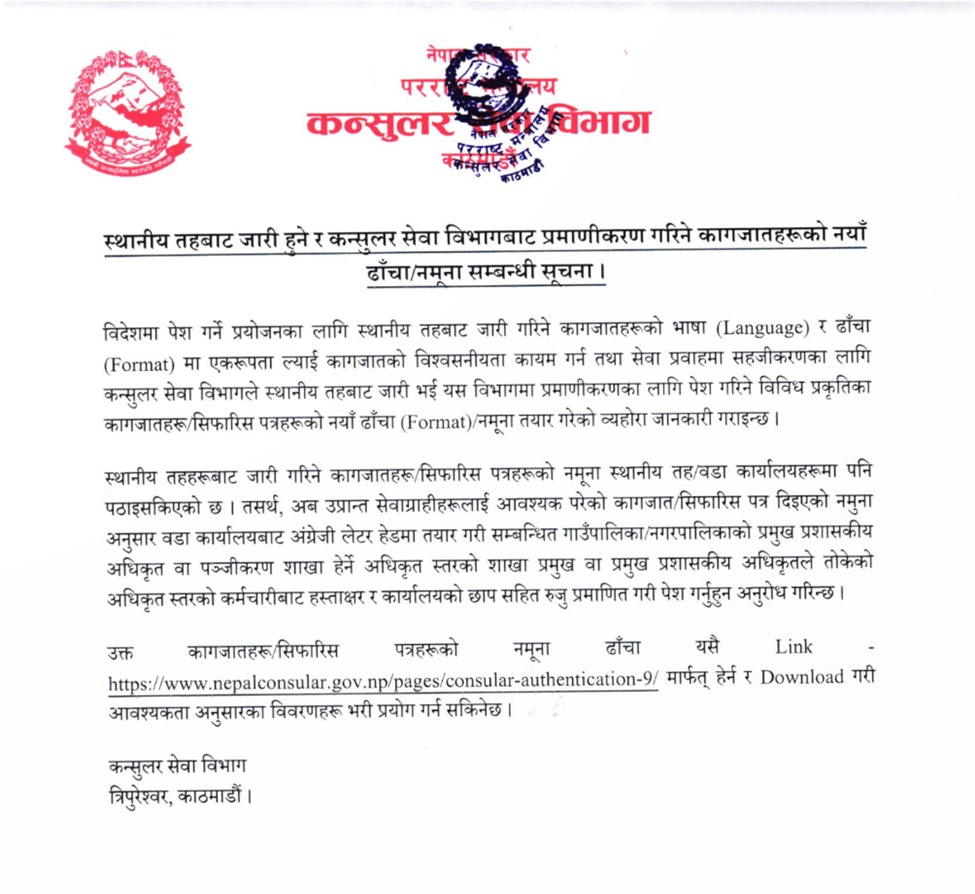
On 9 November 2025 (23 Kartik 2082), the Department of Consular Services under Nepal’s Ministry of Foreign Affairs (MoFA) issued an important notice aimed at standardising the language and format of documents issued by local levels (local governments) for use abroad.
The notice introduces new prescribed formats (samples) for various documents and recommendation letters issued by municipalities, rural municipalities, and ward offices, which are later submitted to the Department of Consular Services for consular authentication and/or apostille as applicable. The primary objective is to ensure uniformity, credibility, and ease of service delivery in the consular authentication and/or apostille process.
All local-level documents and recommendation letters intended for use abroad must now be:
Prepared in English, and
Drafted strictly in accordance with the sample formats issued by the Department of Consular Services.
Documents not following these formats may face delays or rejection during consular authentication or apostille processing.
2. Issuance on English Letterhead by Ward Offices
The notice clearly states that such documents must be:
Prepared by the ward office, and
Issued on an official English letterhead.
This marks a shift from previously accepted Nepali-language or mixed-format documents, particularly for documents intended for consular authentication or apostille for foreign use.
3. Authorised Signatories and Certification
Each document must be:
Properly checked and certified (ruju pramanit), and
Signed and sealed by one of the following authorised officials:
Chief Administrative Officer (CAO);
Officer-level Section Head responsible for Vital Registration (Panchikaran); or
Officer-level employee designated by the CAO.
This requirement reinforces accountability and authenticity for documents submitted for consular authentication or apostille.
4. Availability of Formats Online
The prescribed formats are publicly accessible and downloadable from the official consular website:
Service recipients and local offices are expected to use these templates by filling in the required details as applicable.
C. Practical Implications for Individuals and Institutions
This notice is particularly relevant for individuals and entities requiring documents for:
Foreign employment;
Immigration and residency applications;
Education abroad;
Marriage, birth, relationship, or personal status verification; and
Other cross-border legal or administrative purposes requiring consular authentication or an apostille.
Failure to comply with the new format, language, or certification requirements may result in:
Additional administrative costs,
Re-issuance of documents, or
Delays in consular authentication, apostille issuance and overseas processing.
D. Unofficial English Translation of the Notice
For submission abroad, to bring uniformity in the language and format of documents issued by local levels, to maintain the credibility of such documents, and to facilitate service delivery, this is to inform that the Consular Service Department has prepared a new format/template for various types of documents/recommendation letters issued by local levels and submitted to this Department for authentication.
The sample formats of documents/recommendation letters to be issued by local levels have also already been sent to local levels/ward offices. Therefore, henceforth, it is requested that the documents/recommendation letters required by service recipients be prepared by the ward office in accordance with the prescribed sample, on an English letterhead, and be duly verified and submitted with the signature and official seal of the Chief Administrative Officer of the concerned Rural Municipality/Municipality, or the Section Chief at officer level responsible for the Civil Registration Section, or an officer-level employee designated by the Chief Administrative Officer.
The sample formats of such documents and recommendation letters can be viewed and downloaded through the following link:
The downloaded formats may be completed with the necessary details and used as required.
Department of Consular Services
Tripureshwor, Kathmandu
Note:
“Local level” refers to local government units such as Rural Municipalities and Municipalities.
“Ward office” denotes the administrative office at the ward level.
“Civil Registration Section” refers to the section responsible for civil/personal status registration. The hierarchy of authorized signatories is translated as stated, without resolving potential overlaps or ambiguities in authority.
Certain Nepali administrative terms, such as “ruju pramanit” and “Panchikaran”, are retained with explanatory clarifications to preserve the original legal and procedural meaning.
Disclaimer:
This update is provided for general informational purposes only and does not constitute legal advice. No attorney-client relationship is created through this content. Gandhi & Associates assumes no liability for any consequences resulting from actions taken based on information contained herein.
For quick legal assistance:
Phone/Viber/WhatsApp: +977 9709035477
For guidance specific to your documents, foreign submissions, or consular authentication requirements, please contact our office to schedule a consultation with our experts.
The Advertisement (Regulation) Act, 2076 (2019) (the “Act”), published in the Nepal Gazette on 25 October 2019, is Nepal’s first dedicated statute regulating advertisements of goods, services, events, and programs. Subsequently, the Advertisement (Regulation) Regulation, 2077 (2020) was published in the Nepal Gazette on 19 October 2020. As the foundational legal framework governing advertisement standards, it seeks to enhance consumer protection, reinforce public decency, and regulate the burgeoning advertising industry.
This briefing summarizes the key provisions of the Act and analyses a critical gap within the statute, its silence on surrogate advertising, a practice that has increasingly proliferated across Nepal’s media landscape.
2. Scope of the Act
The Act regulates:
All forms of advertisements, including print, electronic, online and outdoor displays.
Obligations and liability of advertising agencies and advertisement providers.
Permitted and prohibited content, including categories of products and messages that cannot be legally promoted.
Despite its broad scope, the Act does not explicitly regulate social media or digital advertising, nor does it define or prohibit surrogate advertising, thereby leaving regulators without clear procedural guidance or statutory authority to act.
3. Definition and Regulation of Advertisements
3.1 What Constitutes an Advertisement
The Act adopts a broad definition, where “Advertisement” means any word, sentence, drawing, image, symbol, poster, pamphlet, publication, sign, structure or any other audio, visual or audio-visual publication or prepared for publication in public regarding any product, service, event or occasion through the means including print, electronic media, online, social networks, hoarding board, balloon.
This definition effectively captures both traditional and online medium; textual, visual, audio, and audiovisual content disseminated through traditional and digital media, hoarding boards, balloons, and similar means.
3.2 Permitted Advertisements
Advertisements may be made to:
Promote a product or service;
Inform consumers about a product or service;
Publicise programs or events; or
Disseminate public information.
3.3 Prohibited Advertisements
The Act prohibits advertisements that directly or indirectly promote:
Products banned for production, distribution, sale, or use under prevailing laws;
Gambling and unauthorised betting activities;
Weapons, explosives, and similar hazardous products;
Prescription medicines or medical products requiring professional supervision;
Products requiring prior regulatory approval where such approval has not been obtained;
Products explicitly prohibited from advertisement by other applicable laws; and
Educational advertisements inserted into school or university syllabi, except when the information serves a clearly educational purpose and is not promotional.
Additionally, the Act also prohibits any advertisement that:
A. Threatens National Integrity or Public Order
Undermines Nepal’s sovereignty, geographical integrity, nationality, or federal relations;
Disrupts public peace or harms international relations;
Is against the State or in contempt of court; and
Encourages or facilitates criminal conduct.
B. Violates Public Morality or Social Values
Contains abusive, defamatory, or degrading content.
Disrespects labour or promotes discrimination based on sex, caste, religion, language, or economic status.
Hurts religious sentiments or cultural values.
C. Engages in Unfair Market Conduct
Misleads consumers or spreads misinformation.
Disparages or deteriorates the reputation of competing products.
Demoralises domestic industries or harms fair competition.
D. Violates Intellectual Property Rights
Uses trademarks, patents, designs, or other IPR-protected elements without the rights-holder’s consent.
These prohibitions aim to prevent the commercial promotion of harmful, restricted, unregulated or banned products and ensure that advertising activities do not undermine public interest or lawful market conduct.
3.4 Advertisement-Prohibited Areas
Local authorities may designate restricted zones, such as those related to religious, cultural, archaeological, educational, or health institutions.
3.5 Mandatory Disclosure Requirements
Advertisements must disclose:
Name and address of the advertisement provider, and
Warnings on harmful effects, where relevant.
Non-compliance triggers liability for publishers and media owners and may attract a fine of up to NPR 5 lakh.
4. Regulation of Specific Advertising Mediums
4.1 Hoarding Boards
Approval from the local level is required for any hoarding board placed in public view. Applications may be rejected for reasons including interference with transportation, aesthetic disruption, violation of cultural or religious values, or breaches of local law.
4.2 Television (Clean Feed)
The Act enforces Nepal’s clean feed policy, barring all foreign advertisements and prohibiting Nepali media from dubbing foreign ads.
4.3 Written Publications
Print advertisements remain partially governed by the Press and Publication Act but must also comply with the 2019 Act.
4.4 Social Media
The Act contains no explicit regulatory mechanism for advertisements on social media or online platforms, despite their growing role as primary advertising channels in Nepal.
Nepal Rastra Bank’s directive requires payments for online ads to be processed through banking channels for taxation purposes, but this does not regulate advertising content.
4.5 Email/SMS Advertising
Unsolicited email or SMS advertisements without the recipient’s consent are prohibited. However, the Act is silent regarding unsolicited advertising via phone calls, creating another interpretive gap.
5. Advertisement Board
The Act establishes an eight-member Advertisement Board empowered to:
Propose a national advertising policy,
Examine advertisement content,
Develop codes of conduct,
Ensure compliance with standards,
Coordinate among regulators and stakeholders,
Distribute government advertisements proportionately,
Conduct awareness programs, and
Direct advertisers or media houses, where required.
6. State and Local Level Regulation
State-level committees monitor and supervise both print and electronic advertisements, including hoarding boards, based on statutory criteria.
7. Advertisement Agencies
Agencies must be enlisted with the Advertisement Board. Existing agencies at the time of enactment must register within one year.
8. Complaints, Compensation, and Appeal
Complaints may be filed with the Board, committees, or local-level authorities. The action pursuant to the complaint filed should be informed to the complainant by the Advertisement Board, committee or local level.
Compensation may be awarded after an investigation to check whether the harm has been caused or not by unlawful advertisements.
Appeals of decisions must be filed within 35 days to the competent court (District Court or High Court, depending on the level of decision).
9. Offences and Penalties
Penalties include:
Violation Type
Statutory Penalty
Notes
Hoarding board violations
Up to NPR 1,00,000
Includes placement without approval & obstruction of public space
Clean Feed (TV) violations
Up to NPR 5,00,000
Highest penalty category
Restricted area/hour violations
Up to NPR 1,00,000
Applies to areas designated by local authorities
Missing disclosure (advertiser details)
Up to NPR 1,00,000
Liability may shift to publisher
Unsolicited SMS/email ads
Up to NPR 1,00,000
Act is silent on unsolicited calls
Violations without specified penalty
Up to 1 year imprisonment or NPR 10,000 fine
General clause
Editors are protected from liability unless they are also media owners.
10. The Act’s Legal Silence on Surrogate Advertising
10.1. What is Surrogate Advertising?
Surrogate advertising involves promoting a permissible product or service using a name, logo, colour scheme, or brand identity identical or substantially similar to a product whose advertising is prohibited,creating a functional association in the minds of consumers without explicit reference to the prohibited item. The intention is to remind consumers of the prohibited product without explicitly advertising it.
Examples generally involve:
Branding of music products, events, or merchandise using the visual identity of prohibited goods,
Sponsorship arrangements where the surrogate brand closely mirrors a prohibited product’s brand identity,
Use of digital channels to disseminate content indirectly associated with prohibited products.
10.2. Absence of Provisions in the Advertisement (Regulation) Act
While the Act clearly bans direct advertising of alcohol, tobacco, gambling, betting, and other restricted items, it does not prohibit surrogate advertising or provide criteria for determining when an advertisement indirectly promotes a banned product.
This legal omission creates not only an interpretive gap but a practical enforcement vacuum, leading to the following consequences:
Enforcement agencies lack a legal basis to penalise surrogate advertising even when intent is evident.
Brand owners can legally leverage near-identical branding through music labels, entertainment platforms, merchandise, or event sponsorships.
Social media channels, which the Act does not comprehensively regulate, have become a primary space for such activities.
Enforcement, where it occurs, tends to targetindividuals promoting a brand while being unable to act against corporate/beneficiary entities due to the absence of express statutory prohibitions.
10.3. Comparative Insight
Surrogate advertising is not inherently harmful. In other jurisdictions, it is permissible when the surrogate product is genuine and lawfully sold, and when marketing does not mislead consumers. Nepal currently lacks clear standards, leaving stakeholders uncertain about compliance thresholds and permissible brand resemblance.
Introducing clear legal standards, such as definitions, disclosure requirements, and limits on brand resemblance, would help Nepal distinguish between legitimate brand extensions and attempts to bypass statutory advertising restrictions. In the absence of such guidance, regulators, advertisers, and media houses face uncertainty, and enforcement remains inconsistent. Proper regulation would close existing gaps, promote fair competition, and align Nepal with international best practices without impeding legitimate commercial activity.
10.4. Regulatory Challenges
Without explicit statutory authority:
The Advertisement Board may investigate, but cannot impose penalties solely for surrogate advertising.
Complaints filed to regulators cannot result in sanctions unless the content independently violates other provisions (e.g., misleading, discriminatory, or immoral content).
Enforcement appears inconsistent, especially where sponsorships by surrogate brands intersect with public events or government-linked organisations.
11. Conclusion
The Advertisement (Regulation) Act, 2076 (2019) and Regulations, 2077 (2020), are pioneering legal instruments that significantly advance Nepal’s advertisement governance framework. However, its silence on surrogate advertising, combined with underdeveloped digital advertising regulation, has created a legal vacuum that allows indirect promotion of restricted products to persist.
As a result, surrogate branding through events, merchandise, entertainment platforms and online media continues to thrive, exploiting the ambiguity. Regulators, though aware of the issue, remain constrained by the absence of express legislative authority.
A clearer statutory framework, potentially incorporating definitions, thresholds, and enforcement mechanisms for surrogate advertising, would strengthen regulatory capacity and provide much-needed legal certainty to advertisers, agencies, and media houses.
Disclaimer: This article is for general informational purposes only and does not constitute legal advice, advertisement, personal communication, solicitation or inducement. No attorney-client relationship is created through this content. Gandhi & Associates assumes no liability for any consequences resulting from actions taken based on information contained herein.
For specific legal advice regarding advertisement and related platforms in Nepal, please contact our office to schedule a consultation with our experts.
Double taxation occurs when the same income is taxed by two different countries, creating an excessive burden that discourages cross-border trade and investment. In today’s globalized economy where capital, goods, services, and technology move freely across borders, the risk of double taxation has increased significantly. Nepal addresses this challenge through Double Taxation Avoidance Agreements (DTAAs) and provisions in the Income Tax Act, 2058 (2002), providing mechanisms for foreign companies to legitimately avoid paying tax twice on the same income.
II. Understanding Double Taxation
1) Types of Double Taxation
a) Juridical Double Taxation occurs when the same taxpayer is required to pay taxes to two different governments on the same income. This commonly arises when a taxpayer resides in one country but earns income in another, making them liable for taxation in both jurisdictions.
Example: An Indian company providing consulting services to a Nepalese client faces Nepal’s withholding tax on the payment and India’s corporate tax on the same income. Without relief mechanisms, the combined tax burden could exceed 40-50%, making the transaction economically unviable.
b) Economic Double Taxation refers to taxation of the same income by the same government but affecting two different taxpayers. A common example is corporate profits taxed at the company level and then taxed again as dividends in shareholders’ hands.
2) Taxation Principles
Two competing principles create the double taxation problem:
Source-Based Jurisdiction: The country where income originates has the right to tax it. If someone works in Nepal, Nepal claims taxing rights because it provides the opportunity and resources to generate that income.
Residence-Based Jurisdiction: The country where a person or entity resides has the right to tax their worldwide income regardless of where it’s earned. If a corporation is incorporated in India, India claims the right to tax all its income, including from Nepal operations.
When both principles apply simultaneously, double taxation results.
III. Nepal’s Legal Framework
Section 73 of the Income Tax Act, 2058 (2002)
Section 73(1): Power to Conclude International Agreements
The Government of Nepal may conclude international agreements with foreign countries for the avoidance of double taxation when any income of any person is taxable under Nepal’s Income Tax Act and the same income is also taxable in a foreign country.The law defines “international agreement” as any treaty or agreement with a foreign government applicable to Nepal that contains provisions to avoid double taxation and prevent fiscal evasion, or to render reciprocal administrative assistance in implementing tax liability.
Section 73(2) and (3): Collection Assistance
When a competent authority of another treaty country requests Nepal’s Inland Revenue Department to collect amounts payable by persons in arrears under that country’s taxation law, the Department may send written notice requiring payment within a specified date. This collected amount is then sent to the requesting competent authority, facilitating international tax cooperation.
Section 73(4) and (5): Anti-Abuse Provisions
When international agreements contain provisions requiring Nepal to exempt income or payments or apply reduced tax rates, certain entities are denied these benefits to prevent treaty abuse.
Specifically, benefits are denied to entities that are considered residents of the other party country for agreement purposes and where fifty percent or more of the vested ownership is held by individuals or entities (in which individuals have no interest) who are residents of both Nepal and the other treaty country. This provision prevents abuse through dual-resident entities that could manipulate benefits under multiple tax regimes.
IV. Nepal’s DTAA Network
Nepal has concluded DTAAs with eleven countries following principles established by the Organization for Economic Cooperation and Development (OECD) and United Nations (UN). Nepal’s treaty partners include India (first agreement 1987, revised 2011), Norway (1996), Thailand, Sri Lanka, Mauritius, Austria, Pakistan, China, South Korea, Qatar, and Bangladesh (2019). Negotiations continue with additional countries including Singapore, Malaysia, United Kingdom, and Oman.
The India-Nepal DTAA is particularly significant given extensive economic ties between the countries. This agreement, revised in 2011 and effective from March 2012, addresses taxation of business profits, dividends, interest, royalties, technical fees, capital gains, and employment income.
V. Key Concepts in Tax Treaties
1) Permanent Establishment (PE)
Section 68 of the Income Tax Act addresses permanent establishments. A PE represents a fixed place of business through which a foreign enterprise conducts operations in Nepal. Business profits are generally taxable in Nepal only if the foreign company maintains a PE there.
Common PEs include:
Branch offices
Factories or manufacturing facilities
Construction sites exceeding specified durations (typically 6-12 months)
Dependent agents with authority to conclude contracts
Non-PE situations:
Independent agents acting in ordinary business
Storage or display facilities without sales
Purchasing offices
Short-term service provision below treaty thresholds
Practical implication: If an Indian consulting company sends employees to Nepal for a 3-month project, it typically doesn’t create a PE, meaning business profits escape Nepal taxation. However, extending the project beyond 6 months may create a PE, subjecting profits to Nepal tax.
2) Beneficial Ownership
DTAAs apply only to beneficial owners, entities truly entitled to income and controlling its use. This prevents treaty shopping where companies route income through intermediary entities in treaty countries solely for tax benefits without genuine business substance.
Nepal’s tax authorities increasingly scrutinize beneficial ownership, requiring demonstration of real operational presence, decision-making authority, and commercial rationale beyond tax optimization.
3) Tax Residency
Treaties provide guidelines for determining residency of individuals and entities. A Tax Residency Certificate (TRC) issued by the home country tax authority serves as official proof of residence status for treaty purposes. Schedule 11 of the Income Tax Act prescribes the format for TRCs in Nepal.
VI. Methods to Eliminate Double Taxation
1) Exemption Method
The residence country simply exempts foreign-source income from taxation, leaving only the source country to tax. This method provides complete relief but is less common in Nepal’s treaties.
2) Tax Credit Method
The foreign tax credit method is more prevalent. The residence country taxes worldwide income but allows credit for taxes paid in the source country, limited to the lower of actual foreign tax paid or the home country tax attributable to foreign income.
Example:
Income from Nepal: NPR 1,000,000
Nepal withholding tax (10%): NPR 100,000
Home country tax rate (30%): NPR 300,000
Credit for Nepal tax: NPR 100,000
Additional home country tax: NPR 200,000
Total tax: NPR 300,000 (not NPR 400,000 without relief)
VII. Practical Steps for Foreign Companies
Step 1: Verify Treaty Applicability
Confirm whether Nepal has a DTAA with your home country. Identify which treaty articles apply to your specific income type (business profits, dividends, interest, royalties, technical fees). Verify your company qualifies as a treaty resident.
Step 2: Obtain Tax Residency Certificate
Apply to your home country’s tax authority for a TRC certifying your tax residence status. The certificate must be current for the relevant fiscal year and contain company details, tax identification number, and official residence confirmation. Some countries may require apostille or consular authentication.
Step 3: Submit Documentation to Nepal
Before payment occurs, provide the Nepalese payer with required documentation to apply reduced withholding rates:
Valid Tax Residency Certificate
Company incorporation certificate
Treaty benefit claim form
Beneficial ownership declaration
Board resolution authorizing treaty claims
The payer then withholds at the treaty rate rather than domestic rate, providing immediate benefit.
Step 4: Maintain Compliance
File tax returns in Nepal if required (PE cases, certain thresholds). Report Nepal-source income in your home country return. Claim foreign tax credit by attaching Nepal withholding certificates and payment evidence. Maintain documentation for potential audits in either jurisdiction.
VIII. Anti-Abuse Provisions
1) Treaty Shopping Prevention
Treaty shopping involves routing income through entities in treaty countries to obtain benefits not directly available. Nepal’s anti-treaty shopping provisions in Section 73(4) and 73(5) deny benefits to conduit companies lacking genuine substance.
Example: A Bhutanese construction company registers in India solely to access the India-Nepal DTAA for Nepal projects. Nepal may deny treaty benefits if the company lacks genuine Indian substance.
2) Base Erosion and Profit Shifting (BEPS)
Nepal participates in international initiatives addressing Base Erosion and Profit Shifting, tax planning strategies exploiting gaps in tax rules to artificially shift profits to low-tax locations. The OECD/G20 BEPS Package provides 15 Actions giving governments tools to ensure profits are taxed where economic activities occur and value is created.
IX. Conclusion
Nepal’s framework for avoiding double taxation, established through Section 73 of the Income Tax Act and bilateral DTAAs with eleven countries, provides legitimate mechanisms for foreign companies to avoid excessive tax burdens. Success requires understanding treaty provisions, obtaining proper documentation including Tax Residency Certificates, demonstrating beneficial ownership and substance, and maintaining compliance in both jurisdictions.
Disclaimer: This article is for general informational purposes only and does not constitute legal advice, advertisement, personal communication, solicitation or inducement. No attorney-client relationship is created through this content. Gandhi & Associates assumes no liability for any consequences resulting from actions taken based on information contained herein.
For specific legal advice regarding applicability of double tax avoidance in Nepal, please contact our office to schedule a consultation with our experts.