Department of Industry Mandates Online Processing of All Industrial Administration Services Through IMIS

All industrialists and businesspersons registered with or intending to register with the Department of Industry must henceforth submit applications and access industrial administration services exclusively through the Industrial Management Information System (IMIS).

Introduction

The Department of Industry (DOI), under the Ministry of Industry, Commerce and Supplies, Government of Nepal, has issued an urgent notice requiring all industrial administration-related functions to be conducted through the Industrial Management Information System (IMIS).

The notice clarifies that while certain functions were previously carried out through IMIS, all such functions will now be exclusively processed through the system. All industrialists and businesspersons, whether already registered with the DOI or intending to register, are required to submit their applications in accordance with the schedules prescribed under the Industrial Enterprises Act, 2076 (2019) and the Industrial Enterprises Regulations, 2078 (2021) through the IMIS portal.

Key Highlights

  1. All industrial administration-related functions of the DOI are to be conducted exclusively through IMIS with immediate effect.
  2. Both existing registrants and new applicants must submit all applications through the IMIS portal.
  3. Applications must comply with the schedules prescribed under the Industrial Enterprises Act, 2076 (2019) and the Industrial Enterprises Regulations, 2078 (2021).
  4. The following services are to be delivered through IMIS:
  • Approval for Industry Registration;
  • Registration of New Industry;
  • Capital and Capacity Enhancement;
  • Extension of Time Limit for Commencement of Industry Operation, Commercial Production, or Transactions;
  • Transfer of Ownership and Relocation of Industry;
  • Environmental Studies (BES, IEE, EIA, Revised IEE);
  • Obtaining of Facilities and Incentives;
  • Approval of Foreign Investment;
  • Approval of Technology Transfer;
  • Approval of Foreign Investment through Share Purchase or Sale;
  • Recommendation for Business Visa and Non-Tourist Visa;
  • Approval for Repatriation of Investment and Earned Income; and
  • Determination of Raw Material Consumption Norms.

Practical Implications

1. Practical Implications

Industrialists and businesspersons must submit all applications and process all industrial administration matters exclusively through the IMIS portal going forward. Physical or offline submissions will no longer be accepted for the services listed above. Applicants should ensure they are registered on the IMIS platform and familiar with its processes before submitting applications.

2. Impact on Foreign Investors and Technology Transfer Applicants

Foreign investors and parties seeking approval for technology transfer, share purchase or sale, or repatriation of investment and earned income must also route their applications through IMIS. Parties involved in such transactions are advised to review the applicable requirements under the relevant legislation and ensure timely submission through the portal.

3. Consequences of Non-Compliance

Failure to submit applications through IMIS may result in:

  • Non-processing or rejection of applications;
  • Delays in obtaining required approvals, registrations, or incentives; and
  • Disruption to business operations dependent on timely DOI approvals.

All concerned industrialists and businesspersons are urged to transition to IMIS promptly and seek assistance where necessary to ensure uninterrupted access to DOI services.

This article is for general informational purposes only and does not constitute legal advice, advertisement, personal communication, solicitation or inducement. No attorney-client relationship is created through this content. Gandhi & Associates assumes no liability for any consequences resulting from actions taken based on information contained herein.

For quick legal assistance

Phone/Viber/WhatsApp: +977 9709035477

Companies Not Distributing Profits in Nepal

The Companies Act, 2063 (2006) introduced into Nepalese company law a distinct institutional model known as a “company not distributing profits” (मुनाफा वितरण नगर्ने कम्पनी). This structure is designed for organizations that pursue professional advancement, educational initiatives, social development, charitable work, or public utility objectives, but do so within a corporate framework and without distributing profits to their members.

Unlike associations registered under Association Registration Act, a company not distributing profits is incorporated under Chapter 19 of the Companies Act and is therefore governed by corporate law principles, statutory disclosure obligations, and structured regulatory oversight. At the same time, it is legally restrained from operating for private gain.

Under the Act, the term “company not distributing profits” refers to a company incorporated on the condition that profits or savings earned in achieving its objectives shall not be distributed as dividends or otherwise to its members.

1. Statutory Basis and Purpose

    Section 166 of the Companies Act permits incorporation of a company without dividend distribution for specific purposes. The law contemplates formation for the following objectives:

    1. development and promotion of professions or occupations;
    2. protection of collective rights and interests of persons engaged in a particular profession or business;
    3. for scientific, educational, academic, social, charitable/benevolent, public utility, or welfare objectives.

    Incorporation may be initiated by individuals, by the trustees of a public trust registered under prevailing laws of Nepal. The legislative intent is to provide a corporate vehicle to entities that require structured governance and legal personality but do not intend to operate for private profit.

    The law requires that at least five (5) promoters incorporate such a company. After incorporation as well, the number of members must not fall below five (5).

    2. Registration Procedure

    The following procedure is application for the registration of company not distributing profits in Nepal:

    StepsProcedure
    Step 1Reservation of proposed company’s name in the digital portal of Office of Company Registrar’s (the “OCR”) (Camis);
    Step 2Drafting Memorandum of Association, and Articles of Association and uploading in the digital portal of OCR for company registration;
    Step 3After company registration is completed at the OCR, tax registration (PAN/VAT) at the relevant Inland Revenue Office;
    Step 4Business registration at the relevant local level ward office;
    Step 5Enlistment of the company at the Social welfare Council if the company desired to receive foreign grant from foreign countries.

    3. Required Documents for Registration

    The documents required for registration of company not distributing profits are set out below:

    1. Memorandum of Association (“MOA”) and Articles of Association (“AOA”) of proposed company;
    2. Citizenship certificate and National Identity Number of promoters;
    3. If the promoter is a company, a copy of certificate of registration, MOA, AOA and board resolution of the promoter company; and
    4. Application and Power of attorney for the company registration.

    Note: The government registration fees of NPR 15,000 is payable to the Office of the Company Registrar.

    Upon submission of all required documents, the company registration procedure will be completed in seven (7) days.

    4. Capital Structure and Liability

    A defining feature of a company not distributing profits is that share capital is not required. The company does not issue shares and therefore does not have shareholders in the conventional corporate sense. Instead, it is a membership-based entity.

    The absence of share capital does not prevent the company from collecting membership fees or receiving donations and grants permitted by law.

    With respect to liability, members are not personally liable for company debts unless they have expressly agreed in writing to assume liability. Where such written acceptance exists, liability is limited to the extent specified.

    5. Non-Distribution Constraint

    The cornerstone of this legal structure is the absolute prohibition on profit distribution. Section 167 clearly provides that profits, bonuses, or any form of financial benefit cannot be distributed to members or employees. The restriction extends to direct as well as indirect payments, and includes payments to close relatives of members.

    All income and surplus generated by the company must be applied either to capital strengthening or to the attainment of its stated objectives. The non-distribution rule is not merely a policy principle; it is a statutory condition of existence.

    6. Administrative Expense Limitation

    To safeguard the non-profit character of these entities, the Act restricts administrative expenditure. Administrative expenses cannot exceed twenty-five percent (25%) of total expenditure. Furthermore, remuneration, meeting allowances, operational costs, and other payments to officers must remain within limits determined by the Registrar, taking into account the company’s financial condition and income.

    7. Compliance Requirement and Consequence of Non-Compliance

    Section 167 provides that, except for provisions applicable exclusively to companies with share capital, all legal provisions applicable to listed companies apply to companies not distributing profits. This means that three-month compliance, annual compliance, governance standards, disclosure norms, audit requirements, and director responsibilities applicable to listed public companies also extend to these entities. The legislature has thus imposed a higher compliance threshold to ensure accountability.

    Regarding consequence of non-compliance, although companies not distributing profits do not have share capital, in the event of failure to submit required information, statements, or filings within the prescribed period, the company shall be subject to penalties equivalent to those applicable to a public company with paid-up capital of up to NPR 10,000,000 (Nepalese Rupees Ten Million).

    8.  Conclusion

    While companies not distributing profits offer a flexible and credible corporate structure for social and public interest initiatives, registration requires careful legal structuring, particularly in drafting objectives and governance provisions.

    Early legal review and alignment with OCR practice significantly reduce regulatory friction and ensure smoother incorporation. For promoters seeking a compliant and sustainable structure, understanding the registration process is not just procedural, it is foundational.

    Disclaimer: This article is for general informational purposes only and does not constitute legal advice, advertisement, personal communication, solicitation or inducement. No attorney-client relationship is created through this content. Gandhi & Associates assumes no liability for any consequences resulting from actions taken based on information contained herein.

    For quick legal assistance:

    Phone/Viber/WhatsApp: +977 9709035477

    For specific legal advice regarding registration of company not distributing profit in Nepal, please contact our office to schedule a consultation with our experts.

    Department of Industry Requires Authorised Representatives with Valid Identification for In-Person Services

    Businesses and their authorised representatives must carry valid official identification when visiting the Department of Industry in person to access services, as per the notice issued on 2082/12/17 (31 March 2026).

    Introduction

    The Department of Industry (DOI), under the Ministry of Industry, Commerce and Supplies, Government of Nepal, has issued a notice requiring that all persons attending the DOI in person to access its services must be duly authorised representatives of the concerned establishment and must carry valid official identification.

    Key Highlights

    a) Any person attending the DOI in person to access its services must be one of the following:

    • The proprietor or operator of the concerned establishment (firm, company, industry, or business);
    • An employee of the concerned establishment; or
    • An officially designated representative appointed by the establishment.

    b) All such persons must carry a valid official identification document that clearly establishes their identity at the time of the visit.

    c) The DOI is not obliged to provide services to individuals who are unrelated to or not authorised by the establishment concerned.

    d) This requirement applies to all in-person services accessed at the DOI.

    Practical Implications for Non-Compliance

    Failure to comply with the identification and authorisation requirements may result in:

    • Refusal of service at the DOI counter;
    • Delays in completing the required service; or
    • The need to arrange for a properly authorised representative with valid identification to attend in place of the original visitor, causing further inconvenience and loss of time.

    Establishments are therefore advised to ensure that any person attending the DOI on their behalf is formally authorised in advance and carries the necessary official identification to establish both their identity and their connection to the establishment.

    This article is for general informational purposes only and does not constitute legal advice, advertisement, personal communication, solicitation or inducement. No attorney-client relationship is created through this content. Gandhi & Associates assumes no liability for any consequences resulting from actions taken based on information contained herein.

    For quick legal assistance

    Phone/Viber/WhatsApp: +977 9709035477

    Tax Treatment of Preference Share Transfers: IRD Clarifies Applicability of Change in Control under Income Tax Act, 2058 (2002)

    The Ministry of Finance Nepal, through the Inland Revenue Department (the “IRD”), has issued a public circular clarifying the applicability of change in control provisions under the Income Tax Act, 2058 (2002) in relation to changes in ownership of preference shares.

    This circular was published on 2082/10/13 (27 January 2026), pursuant to a decision dated 2082/10/09 (23 January 2026), under Section 75(1) of the Income Tax Act, 2058 (2002).

    Key Clarification

    The circular provides guidance on whether a change in ownership of preference shares constitutes a “change in control” under Section 57 of the Income Tax Act, 2058 (2002).

    Based on an analysis of the Income Tax Act, 2058 (2002), the Companies Act, 2063 (2006), and the Nepal Financial Reporting Standards (NFRS), the IRD has clarified the following:

    1. Exclusion from Change in Control (Section 57):

    Preference shares shall not be considered for the purpose of determining change in control if:

    1. They do not carry voting rights; or
    2. They carry voting rights only in matters relating to preference shares; and
    3. They are of a nature that does not affect the control of the entity.

    This interpretation is aligned with Section 65(3)(e) of the Companies Act, 2063 (2006).

    2. Inclusion in Certain Cases:

    Where preference shares:

    1. Carry broader voting rights; or
    2. Have the effect of influencing or altering control of the entity,

    such shares must be taken into account for the purpose of determining change in control under Section 57 of the Income Tax Act, 2058 (2002).

    Practical Implications for PE/VC Transactions

    This clarification is particularly relevant in the context of private equity and venture capital investments in Nepal, where preference shares (including instruments such as CCPS and redeemable preference shares) are commonly used to structure investments.

    The IRD’s position reinforces that purely economic preference instruments, where investors are granted preferential dividend or liquidation rights without substantive control or voting rights, should not, in principle, trigger “change in control” implications under Section 57.

    Conversely, where such instruments are structured with enhanced voting rights, board influence, or other control-linked features, they may be taken into account for determining change in control. From a structuring perspective, this underscores the importance of carefully calibrating investor rights in preference share instruments to avoid unintended tax consequences.

    Conclusion

    This clarification provides important interpretative guidance for taxpayers and companies issuing or transferring preference shares, particularly in assessing tax implications arising from restructuring or ownership changes.

    The circular has been made publicly available on the official website of the Inland Revenue Department (www.ird.gov.np), and stakeholders are advised to take note accordingly.

    Department of Industry Issues Notice on Prohibited Grounds for Trademark Registration

    Trademark applicants must ensure their applications are based on original creations and do not fall under the prohibited grounds listed under Schedule 5 of the Trademark Directive, 2072 (2015), as per the notice issued by the Department of Industry on 2082/12/18 (1 April 2026).

    Introduction

    The Department of Industry (DOI), under the Ministry of Industry, Commerce and Supplies, Government of Nepal, has issued a notice reminding all trademark applicants of the grounds on which trademark registration applications will not be processed.

    According to the notice published on 2082/12/18 (1 April 2026), applications for trademark registration must be filed in accordance with the Patent, Design and Trademark Act, 2022 (1965) and prevailing laws, with due regard to the prohibited grounds listed under Schedule 5 of the Trademark Directive, 2072 (2015). The DOI has further clarified that applications must be based on the applicant’s own original creation, and that any application found to contain the prohibited elements will not be advanced in the trademark registration process.

    Key Highlights

    1. All trademark registration applications must be based on the applicant’s original creation and filed in compliance with the Patent, Design and Trademark Act, 2022 (1965) and the Trademark Directive, 2072 (2015).
    2. Applications containing any of the following elements will not be processed:
    • Marks that are detrimental to the reputation of any person or institution;
    • Marks that are contrary to public morality, ethics, or religious, social, or cultural decency, or that adversely affect national interest;
    • Marks that prejudice the reputation of other’s trademark;
    • Marks that are likely to cause confusion with a trademark already registered or pending registration in another person’s name;
    • Marks that are similar to the flag, emblem, name, or abbreviation of any country or international organisation, or the name, seal, or logo of a government body;
    • Marks that appear on the World Health Organization’s generic list for pharmaceuticals;
    • Marks that are similar to the Olympic symbol;
    • Marks that are similar to well-known trademarks;
    • Marks that are similar to the name of a public body or public designation;
    • Marks that adversely affect Nepal’s relations with neighboring, friendly, or international organisations;
    • Marks formed by adding a prefix or suffix to an already registered trademark;
    • Marks that are similar to a geographical name or that give a false indication of geographical origin;
    • Marks containing words denoting an ethnic group listed in the latest national census report;
    • Marks consisting of descriptive words relating to the goods or services themselves; and
    • Marks containing signs, words, or logos prohibited under prevailing law.

    Practical Implications

    Practical Implications

    1. Pre-Filing Review of Trademark Applications

    Applicants intending to file trademark registration applications with the DOI must carefully review their proposed marks against the prohibited grounds set out in Schedule 5 of the Trademark Directive, 2072 (2015) prior to submission.

    2. Requirement of Original Creation

    The DOI has emphasised that trademark applications must be based on the applicant’s own original creation. Applicants should therefore avoid adopting or adapting marks that are derivative of, or similar to, existing registered trademarks, well-known marks, or marks belonging to public bodies, international organisations, or government institutions.

    Applicants are strongly advised to conduct a thorough trademark clearance search and seek professional legal advice prior to filing, in order to assess whether their proposed mark may fall within any of the prohibited categories.

    This article is for general informational purposes only and does not constitute legal advice, advertisement, personal communication, solicitation or inducement. No attorney-client relationship is created through this content. Gandhi & Associates assumes no liability for any consequences resulting from actions taken based on information contained herein.

    For quick legal assistance

    Phone/Viber/WhatsApp: +977 9709035477

    Episode 7 | Project Cost Breakdown

    In this episode of Decoded by Gandhi & Associates, Avash Pandit leads a focused discussion on Project Cost, breaking down how project expenses are identified, estimated, and managed across the entire project lifecycle. The episode covers key elements such as budgeting, resource allocation, cost estimation methods, and financial planning, along with practical strategies to keep projects within budget.

    Through real-world examples and clear insights, the discussion helps students, professionals, and project teams understand the importance of effective cost management in ensuring smooth execution and financial efficiency.

    Conclusion: This episode provides clear and practical insights into project cost management, helping students and professionals understand how to plan budgets, control expenses, and ensure projects are completed efficiently within financial limits.

    Labour Compliances in Nepal

    Labour compliance in Nepal is more than a procedural requirement; it is the structural foundation for a stable, lawful, and efficient business. Compliance ensures that employers mitigate financial, operational, and reputational risks while fostering harmonious employer-employee relations.

    The legal framework governing labour compliance is anchored primarily in:

    1. Labour Act, 2074 (2017);
    2. Labour Regulations, 2075 (2018);
    3. Social Security Act, 2075 (2018);
    4. Bonus Act, 2030 (1974);
    5. Social Security Schemes Operational Directives, 2075 (2018).

    These laws set the minimum standards for employment, meaning any employment contract offering less than the prescribed benefits is legally void. While employers may voluntarily provide better benefits, compliance with the statutory baseline is mandatory.

    1. Applicability

    The Labour Act applies broadly to employment relationships across the private and organized sectors in Nepal. The law adopts a wide definition of both “employer” and “enterprise,” ensuring that most forms of organized employment fall within its regulatory scope. In general, unless an employment relationship is specifically governed by another law providing service conditions and benefits, the Labour Act applies as the default labour legislation in Nepal. For clarity, the scope of application can be understood as follows:

    Applicable:

    1. Any person or enterprise employing labour;
    2. Managers acting on behalf of an enterprise;
    3. Labour suppliers providing workers under labour-supply arrangements;
    4. Enterprises including companies, private firms, partnership firms, cooperative organizations, associations, or any organization established or operating under prevailing law, whether operating with or without profit motive.

    Non-Applicable (Section 180 of the Labour Act):

    1. Nepal Army, Nepal Police, Armed Police Force, and National Investigation Department;
    2. Civil service employees governed by civil service laws;
    3. Services established under special legislation where service conditions and benefits are governed by such laws;
    4. Services operating within Special Economic Zones where separate legal provisions apply.

    Where a special law governing employment does not address remuneration, service conditions, or employee benefits, the relevant provisions of the Labour Act shall automatically apply. Likewise, where an employer governed by the Working Journalists Act, 2051 (1993) executes an employment contract applying the Labour Act, the provisions of the Labour Act shall apply to those employees.

    2. Employment Categories and Contractual Obligations

    A well-defined employment structure is key to legal and operational clarity. Nepalese law recognizes five distinct categories of employment, details of which are as follows:

    1. Regular Employment: Ongoing employment that does not fall under other types of employment;
    2. Work-Based Employment: Tied to a specific work/task, ends when the work/task is completed;
    3. Time-Based Employment: Fixed-duration contracts for completing a specific task;
    4. Casual Employment: Short-term work up to 7 days per month;
    5. Part-Time Employment: Employees working 35 hours or less per week.

    Nepalese labour law requires a written employment agreement for all employees except for “Casual Employment.” These agreements define the employment relationship, remuneration, benefits, and working conditions.

    Probationary Period: New employees are subject to a maximum of 6-month probation. Employers may terminate unsatisfactory employees during this period.

    3. Working Hours, Overtime, and Leave Entitlements

    3.1 Working Hours

    The standard work schedule is 8 hours per day and 48 hours per week, with a mandatory 30-minute break after 5 hours of continuous work.

    3.2 Overtime

    Overtime work is permitted up to 4 hours per day and 24 hours per week, compensated at 1.5 times the hourly rate.

    3.3 Leave Entitlements

    Employees are entitled to different types of leave, some of which are guaranteed by law, while others are provided at the discretion of the employer:

    • Weekly Holiday (1 day/week);
    • Public Holidays (13–14 days).
    • Sick Leave (12 days/year, which can be accumulated up to 45 days);
    • Home Leave (1 day per 20 worked, which can be accumulated up to 90 days);
    • Maternity Leave (98 days, 60 fully paid);
    • Paternity Leave (15 days);
    • Paternity Leave (15 days).

    While sick, maternity, and mourning leave are matters of right and must be granted as per law, home leave, paternity leave, and public holidays are considered discretionary, and the employer may adjust the timing based on operational requirements.

    4. Remuneration, Benefits, and Social Security

    Fair remuneration and social security compliance are critical pillars of labor law in Nepal. They protect employees and reduce employer liability.

    Current Minimum Wage: NPR 19,550 per month, generally structured as 60% basic salary and 40% allowances.

    Other Benefits:

    4.1 Grade Increment

    Employees are entitled to an annual grade increment of at least half a day’s basic salary for each completed year of service, unless a higher increment is provided under company policy or employment agreement.

    4.2 Festival Allowance

    Employers must provide a festival allowance equivalent to one month’s basic salary to employees who have completed one year of service. Employees who have not completed one year are entitled to the allowance on a pro-rata basis. In practice, this allowance is commonly paid during major national festivals such as Dashain, though the timing may be determined by the employer.

    4.3 Social Security Fund (SSF)

    The Social Security Fund is a mandatory contribution-based social protection system established under the Social Security Act, 2075. Employers are required to enroll employees in the SSF and deposit monthly contributions based on the employee’s basic salary.

    The contribution structure is as follows:

    Employer Contribution (20%):

    1. Provident Fund : 10%
    2. Gratuity : 8.33%
    3. Social Security Schemes : 1.67%

    Employee Contribution (11%):

    Provident Fund and insurance schemes deducted from the employee’s basic salary. Mandatory contribution-based system:

    4.4 Bonus Entitlement

    The Bonus Act, 2030 (1974) establishes a statutory profit-sharing framework between employers and employees. Enterprises that earn net profit in a fiscal year are required to allocate a portion of that profit for employee bonus distribution. The objective of the law is to ensure that employees benefit from the financial performance of the enterprise.

    The key compliance requirements under the Bonus Act are as follows:

    1. Eligibility:

    Employees who have worked for at least six months during the fiscal year are entitled to receive bonus.

    • Bonus Allocation:

    Enterprises must allocate 10% of net profit to a bonus fund after payment of taxes and statutory allocations.

    • Maximum Bonus Limit:

    The Act prescribes ceilings on bonus distribution:

    • Employees earning up to twice the minimum wage: up to eight months’ salary.
    • Employees earning more than twice the minimum wage: up to six months’ salary.
    • Distribution Timeline:

    Bonus must be distributed within eight months from the end of the fiscal year.

    • No-Profit Situation:

    If the enterprise does not generate net profit in a fiscal year, bonus distribution is not mandatory. However, employers should maintain proper financial records to demonstrate the absence of distributable profit.

    5. Termination of employment

    The Labour Act, 2074 (2017) provides specific rules governing the termination of employment in Nepal, which vary depending on the nature of employment and the grounds for termination. Compliance with these provisions is essential to ensure that termination is legally valid and enforceable.

    In the case of time-bound employment, the employment relationship automatically terminates upon expiry of the period specified in the employment agreement. However, where the duration of a project is extended due to the nature of work, the employment may continue until completion of the extended term.

    Similarly, work-based employment terminates upon completion of the specific work or project for which the employee was engaged. Where the scope of work expands or remains incomplete due to operational requirements, the employment must continue until such work is fully completed.

    For casual employment, which is inherently short-term and intermittent, the employment may be terminated by either the employer or the employee at any time, without the requirement of formal notice.

    Apart from termination based on the nature of employment, an employee may voluntarily terminate the employment relationship by submitting a written resignation. The employer is required to acknowledge such resignation within fifteen days, failing which it is deemed accepted. Termination may also be initiated by the employer on legally recognized grounds, including unsatisfactory performance, physical or mental incapacity affecting work, or misconduct. In such cases, the employer is generally required to follow due process, including providing the employee an opportunity to respond before taking a final decision.

    Except in cases of misconduct or where otherwise exempted, termination of employment requires prior notice. The applicable notice period is based on the period of employment, which includes,  for employment up to 4 weeks: 1 day; for employment of 4 weeks to 1 year: 7 days; and for employment period of more than 1 year: 30 days. Where notice is not provided, payment in lieu of notice must be made.

    Employers may also terminate employment through retrenchment in circumstances such as financial constraints, restructuring, or closure of operations, subject to payment of statutory compensation. Additionally, employees are subject to compulsory retirement upon attaining the age of 60 years, unless otherwise approved.

    Upon termination, the employer must settle all outstanding remuneration and statutory benefits within the prescribed timeframe and provide a certificate of employment. Any employee aggrieved by termination has the right to seek legal remedy before the Labour Court.

    Disclaimer: This article is for general informational purposes only and does not constitute legal advice, advertisement, personal communication, solicitation or inducement. No attorney-client relationship is created through this content. Gandhi & Associates assumes no liability for any consequences resulting from actions taken based on information contained herein.

    For quick legal assistance:

    Phone/Viber/WhatsApp: +977 9709035477

    For specific legal advice regarding labour compliances, and labour-related issues in Nepal, please contact our office to schedule a consultation with our experts.

    Office of the Company Registrar Requires Authorized Representatives with Valid ID for In-Person Services

    Introduction

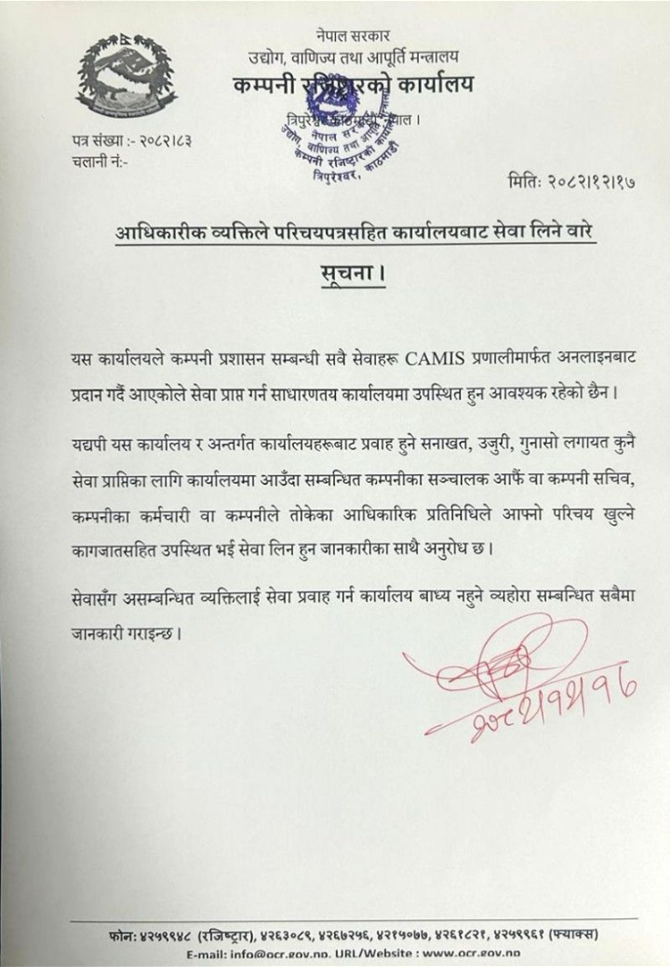
    The Office of the Company Registrar (OCR), under the Ministry of Industry, Commerce and Supplies, Government of Nepal, has issued a notice on 2082/12/17 (31 March 2026) reminding companies and their representatives that in-person visits to the OCR ad its subordinate offices must be made exclusively by authorized persons carrying valid identification documents.

    Key Highlights

    All company administration services are ordinarily delivered online through the CAMIS portal; in-person attendance is generally not required.

    Where a physical visit to the OCR or its subordinate offices is necessary, only the following persons are authorized to attend on behalf of a company:

    • A director of the concerned company;
    • The company secretary;
    • An employee of the company; or
    • An officially designated representative appointed by the company.

    All such persons must present valid identity documents at the time of the visit.

    The OCR has further clarified that it is not obliged to provide services to persons who are unrelated to or unauthorized by the company, and has requested all concerned parties to ensure compliance with this requirement going forward.

    This requirement applies to all in-person services including identification/verification (sanaakhat), complaints, grievances, and any other services accessed at the office counter.

    Actual Snapshot of the Notice:

    This article is for general informational purposes only and does not constitute legal advice, advertisement, personal communication, solicitation or inducement. No attorney-client relationship is created through this content. Gandhi & Associates assumes no liability for any consequences resulting from actions taken based on information contained herein.

    For quick legal assistance

    Phone/Viber/WhatsApp: +977 9709035477