
The Latest Amendment to the Arbitration Act, 2055 (1999)

The Government of Nepal has introduced a significant amendment to the Arbitration Act, 2055 (1999) aimed at enhancing efficiency and aligning the arbitration framework with international standards. These changes were brought into effect on 18 Chaitra 2081 (31 March 2025) through the Act to Amend Some Nepal Acts Relating to Improving Economic and Business Environment and Enhancing Investment, 2081 (2025).

The key highlights of the amendment are provided below:

  1. Introduction to Fast-track Arbitration

Previously, the Arbitration Act 2055 (1999) did not recognize or provide for the mechanism of fast-track arbitration.

Now, the amendment has introduced a new provision under Section 13A of the Arbitration Act 2055 (1999), which allows the parties to settle disputes through fast-track arbitration services as prescribed by contract or agreement between them.

  • Grounds to invalidate an arbitral award

Previously, as per Section 30(3) (b) of the Arbitration Act 2055 (1999), arbitral awards could be invalidated on a few grounds, including:

  • where the dispute decided by the arbitral tribunal was not capable of settlement by arbitration under the laws of Nepal; and
  • where the decision of the arbitrator was likely to prove detrimental to public interests or policies.

Now, the amendment has revised Section 30(3) (b), removing “detrimental to public interests” as a ground for invalidating arbitral awards.

In addition, the newly inserted Section 30(4) provides that, while adjudicating applications to invalidate an arbitral award, the High Court shall not re-examine the merits of the case by re-evaluating the evidence. Furthermore, in case a party submits a separate application requesting to halt the enforcement proceeding, the High court may grant such a stay order only in the following circumstances:

  1. There is prima facie evidence of fraud or corruption, or
  2. There is substantive evidence that the applicant will suffer from irreparable harm if enforcement proceeds. 
  • Enforcement of an arbitral award

For the enforcement of an arbitral award, the concerned parties are under an obligation to implement the award of the arbitrator within 45 days from the date when they receive a copy of the award pursuant to Section 31 of the Arbitration Act 2055 (1999).

In this regard, previously, where an arbitral award was not implemented within the aforementioned time limit, the concerned party could file a petition before the District Court within 30 days of the expiry of such time limit. Upon such petition, the District Court was required to implement the award, ordinarily within 30 days, as if it were its own judgment pursuant to Section 32 of the Arbitration Act 2055 (1999).

Now, with the amendment to Section 32, in case of an award through fast-track arbitration, the District Court is required to enforce the award within 15 days.

Disclaimer: This article is for general informational purposes only and does not constitute legal advice, advertisement, personal communication, solicitation or inducement. No attorney-client relationship is created through this content. Gandhi & Associates assumes no liability for any consequences resulting from actions taken based on information contained herein.

For quick legal assistance:

Phone/Viber/WhatsApp: +977 9709035477

For specific legal advice regarding arbitration proceedings and the enforcement of arbitral awards in Nepal, please contact our office to schedule a consultation with our experts.
 

Trademark Registration Notice issued by the Department of Industry

On 19 August 2025, the Department of Industry (DOI) under the Ministry of Industry, Commerce and Supplies, published a notice requiring trademark applicants and owners to complete pending formalities pursuant to the Patents, Designs and Trademarks Act, 2022 (1965).

Compliance Requirements & Practical Implications

  1. Trademark Applicants – 90-day deadline (by 17 November 2025):
    First, ascertain whether your applications are pending publication, awaiting certificate collection, or have already been registered. Then, within 90 days of publication of this notice:
    1. Submit any missing documents for pending applications that have not yet been published in the Industrial Property Bulletin.
    2. Collect trademark registration certificates upon payment of the prescribed fee.
    Failure to comply will result in automatic dismissal of the application and lapse of registration on the 91st day.

  2. Registered Trademark Owners – 60-day deadline (by 18 October 2025):
    Gather and submit proof of trademark use or product samples to the DOI. Acceptable proof may include:
    • Product packaging or labels bearing the trademark.
    • Advertising or promotional materials.
    • Invoices, receipts, or export/import documents showing use.
    • Website screenshots or online listings.
    • Physical product samples.
    Failure to provide proof may expose the mark to cancellation for non-use.

  3. Businesses entering the Nepalese market:
    1. Ensure trademark counsel or agents are monitoring deadlines under the DOI’s notice.
    2. Factor in compliance timelines when planning brand launches.
    3. Maintain records of use for future verification and enforcement purposes.

G&A’s Commentary
This notice underscores the DOI’s strict enforcement of procedural requirements and the “use it or lose it” principle for trademark protection in Nepal. Trademark owners and applicants must not assume that filings alone are sufficient; timely compliance with administrative and evidentiary requirements is crucial to securing and maintaining protection.
We strongly encourage you to contact us immediately if this notice may apply to your filings or registrations. Taking early action will help safeguard your rights and prevent cancellation.

Disclaimer:
This G&A Update provides a summary of a government notice on trademark registration and compliance requirements in Nepal. It is intended for general information purposes only and should not be taken as legal advice. For specific guidance, please consult Gandhi & Associates.

For quick legal assistance:
Phone/Viber/WhatsApp: +977 9709035477
For specific legal advice regarding trademark registration and compliance requirements in Nepal, please contact our office to schedule a consultation with our experts.
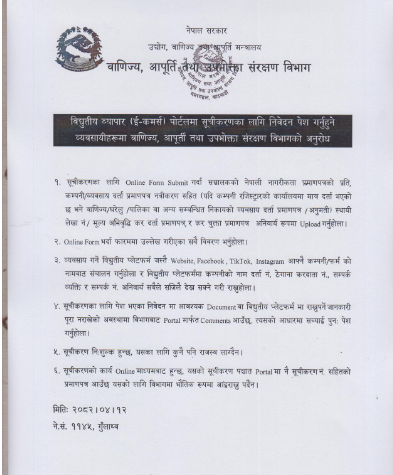
Department of Commerce, Supply and Consumer Affairs requests businesses to submit listing forms on e-commerce portals

The Government of Nepal, through the Ministry of Industry, Commerce, and Supplies (“Ministry”), has issued a notification regarding businesses to submit listing forms on e-commerce portals. This announcement was published on 12 Shrawan 2082 (28 July 2025).

Key Compliance Deadlines:

  • All businesses operating through electronic platforms (e.g., Websites, Facebook, TikTok, Instagram, etc.) to submit their listing forms through the designated online e-commerce portal.

Failure to comply may result in regulatory penalties or restrictions on business operations.

Before the above announcement, an earlier notices were published on by 2 Shrawan 2082, i.e. 18 July 2025 and 18 Asar 2082 i.e.2 July 2025.

This announcement illustrates:

Steps Required:

  1. Fill in the online form and ensure that all required fields and details are accurately filled out.
  2. Operate electronic platforms:
  • Run your business’s website, Facebook, TikTok, Instagram, etc., under your company/firm’s official name.
  • Clearly display the following on the platform:
  • Company name
  • Registration number
  • Address
  • Taxpayer number
  • Contact person and contact number
  • Correction and Resubmission:
  • If the application is incomplete or missing required documents or information on the electronic platform, the department will send comments through the portal. Make the necessary corrections and resubmit the application through the same portal.
  1. Facilitation is free, no revenue is required for it.
  2. The entire listing process is conducted online through the designated portal. Once completed, a certificate containing the listing number will be issued digitally, eliminating the need for any physical visit to the department.


Documents Required for Listing:

When submitting the online form for listing, you must upload the following documents:


  1. Copy of the director’s Nepali citizenship certificate
  2. Company/Business registration certificate renewal

If registered only with the Office of the Registrar of Companies, then include:

  • Business registration certificate or
  • Permission from the Commercial Household, Municipality, or other relevant authority
  1. Permanent Account Number (PAN)/Value Added Tax (VAT) registration certificate
  2. Tax payment certificate


The full text of the notice published by the Department can be found below:


Notice dated on 12 Shrawan 2082(28 July 2025)

Disclaimer:

This G&A Update has been prepared by Gandhi & Associates for general informational purposes only. It does not constitute legal advice. For advice on specific transactions or matters, please contact our team.

For quick legal assistance:

Phone/Viber/WhatsApp: +977 9709035477

For specific legal advice regarding registration of your e-commerce platform and its compliances, please contact our office to schedule a consultation with our experts.
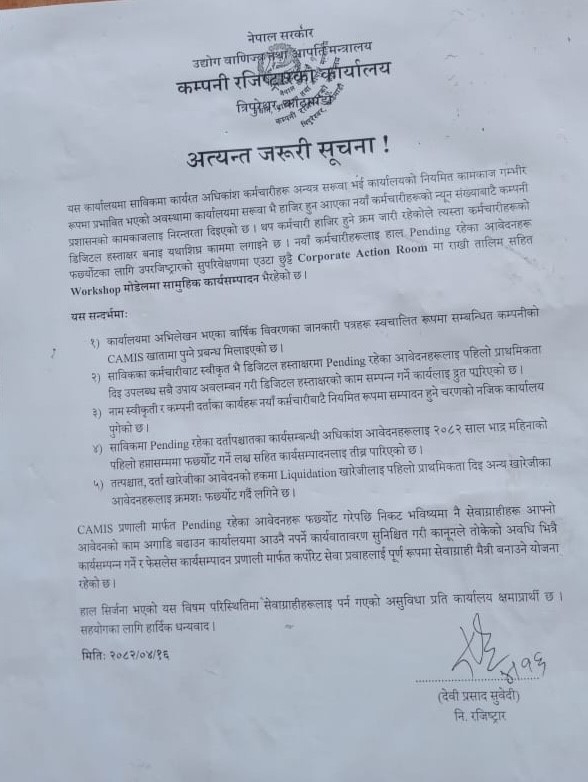
OCR’s Urgent Notice: Temporary Service Delays

Dated: 16th Shrawan, 2082 (1st August, 2025)

In an official notice dated  (1st August, 2025), Office of the Company Registrar (OCR) acknowledged a significant operational disruption due to staff reshuffle. OCR is currently operating with a minimal number of newly transferred employees, which has slowed down company-related processing.

Key Highlights of the Notice:

  • Widespread staff transfer has disrupted normal OCR operations.
  • A Corporate Action Room has been established to train and deploy new staff under Deputy Registrar supervision.
  • Pending digital signature applications approved by outgoing staff are being fast-tracked.
  • Annual return notices archived at OCR will now auto-sync to company CAMIS accounts.
  • Name approvals and new company registrations are being handled by newly assigned staff.
  • Most post-registration filings are targeted for resolution by mid-August 2025.
  • Deregistration cases (starting with liquidation matters) to be addressed sequentially.
  • OCR aims to move toward a faceless, fully digital service model post-clearance.

Measures Taken by OCR:

The OCR has publicly acknowledged a major disruption in service delivery following the large-scale transfer of its former staff. With only a limited number of newly transferred personnel currently on-site, daily operations have been constrained. Nevertheless, the OCR is maintaining essential services through the following measures:

  1. A designated Corporate Action Room has been created where new staff receive training and perform tasks in a supervised workshop-style format.
  2. Applications already approved by former staff but pending due to digital signature delays are being prioritized for immediate completion.
  3. Archived annual return-related notice letters are now automatically uploaded to companies’ CAMIS accounts, eliminating the need for separate follow-ups.
  4. The new team is now handling name approval and company registration tasks, marking a return to procedural normalcy for front-end filings.
  5. The office is accelerating efforts to clear a significant backlog of post-registration filings (e.g., amendments, share updates, board changes) with a goal of completion by the first week of Bhadra 2082 (mid-August 2025).
  6. Following this, deregistration applications, starting with liquidation-related cases, will be processed in a phased manner.

Once the pending applications submitted through the CAMIS system have been cleared, OCR has reaffirmed its commitment to transforming its service delivery into a faceless, fully digital system, ensuring service seekers can process applications remotely within prescribed legal timelines.

Disclaimer:
This G&A Update has been prepared by Gandhi & Associates for general informational purposes only. It does not constitute legal advice. For advice on specific transactions or matters, please contact our team.

For quick legal assistance:

Phone/Viber/WhatsApp: +977 9709035477

For specific legal advice regarding your company and its compliance, please contact our office to schedule a consultation with our experts.
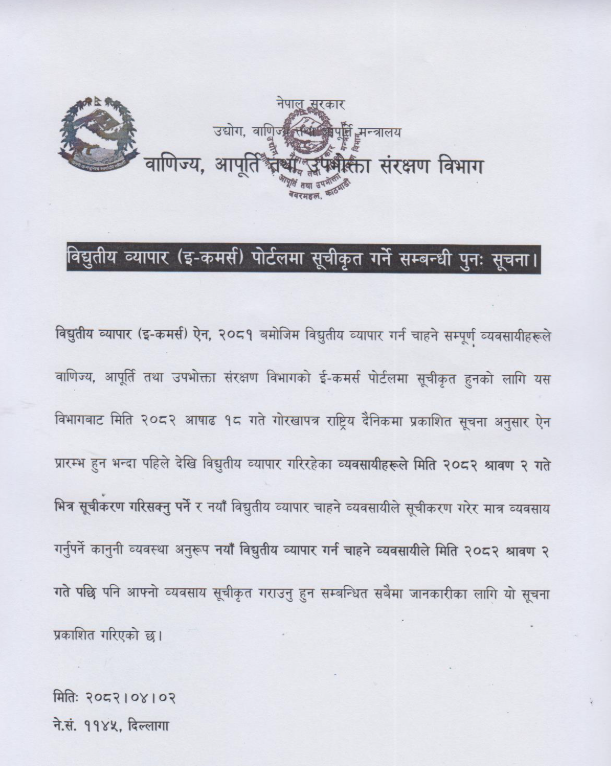
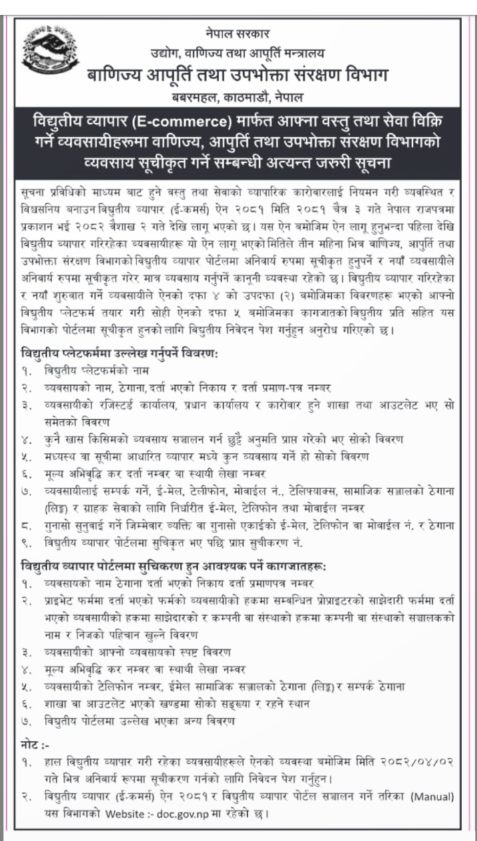
Registration of E-commerce Platform on E-commerce Portal

The Government of Nepal, through the Ministry of Industry, Commerce, and Supplies (“Ministry”), has issued a re-notification regarding mandatory registration for all businesses engaged in e-commerce activities. In line with the Electronic Commerce (E-Commerce) Act, 2081, all entrepreneurs conducting electronic business must register on the official e-commerce portal of the Department of Commerce, Supplies, and Consumer Protection (“Department”). This announcement was published on 2 Shrawan 2082 (18 July 2025). Additionally, under the E-commerce Act 2081 (2025), Chapter 2, Section 4, it is stipulated that every e-commerce platform is required to operate through a duly registered website.

Key Compliance Deadlines:

  • Entrepreneurs already operating electronic businesses before the enactment of the Act must register by 2082 Shrawan 2, ie 18th July, 2025
  • New entrepreneurs wishing to engage in e-commerce must register before commencing operations.

*Failure to comply may result in regulatory penalties or restrictions on business operations.*

Before the above announcement, an earlier notice was published on 18 Asar 2082 (2 July 2025). The announcement illustrates:

Details to be mentioned on the electronic platform:


  1. Name of the e-commerce platform.
  2. Business name, address, registered entity type, and registration certificate number.
  3. Details of the registered office, head office, and any branches or outlets where the business is conducted, if any.
  4. Details of any separate permission obtained to operate a specific type of business.
  5. Information on whether the business operates as a direct seller, intermediary, or list-based platform.
  6. Value Added Tax (VAT) Registration Number or Permanent Account Number (PAN).
  7. Contact details of the business owner, including email address, telephone number, mobile number, fax, social media links, and designated contact details (email, telephone, and mobile) for customer service.
  8. Email address, telephone or mobile number, and physical address of the person or unit responsible for handling customer complaints.
  9. Listing number received after successful registration on the electronic trading portal.


Documents required:

  1. Business name, address, and registered entity registration certificate number.
  2. In the case of a private firm, the name and identifying details of the proprietor; in the case of a partnership firm, the name of the partner; and the case of a company or organization, the name and identifying details of the director.
  3. The entrepreneur provided a clear description of the business.
  4. Value Added Tax (VAT) Number or Permanent Account Number (PAN).
  5. Telephone number, email address, social media link, and contact address of the business owner.
  6. If there is a branch or outlet, its number and location.
  7. Any other information required by the electronic portal.


The full text of notices published by the Department can be found below:

Disclaimer:

This G&A Update has been prepared by Gandhi & Associates for general informational purposes only. It does not constitute legal advice. For advice on specific transactions or matters, please contact our team.

For quick legal assistance:

Phone/Viber/WhatsApp: +977 9709035477

For specific legal advice regarding registration of your e-commerce platform and its compliances, please contact our office to schedule a consultation with our experts.

Revised Minimum Wage in Nepal (2025)

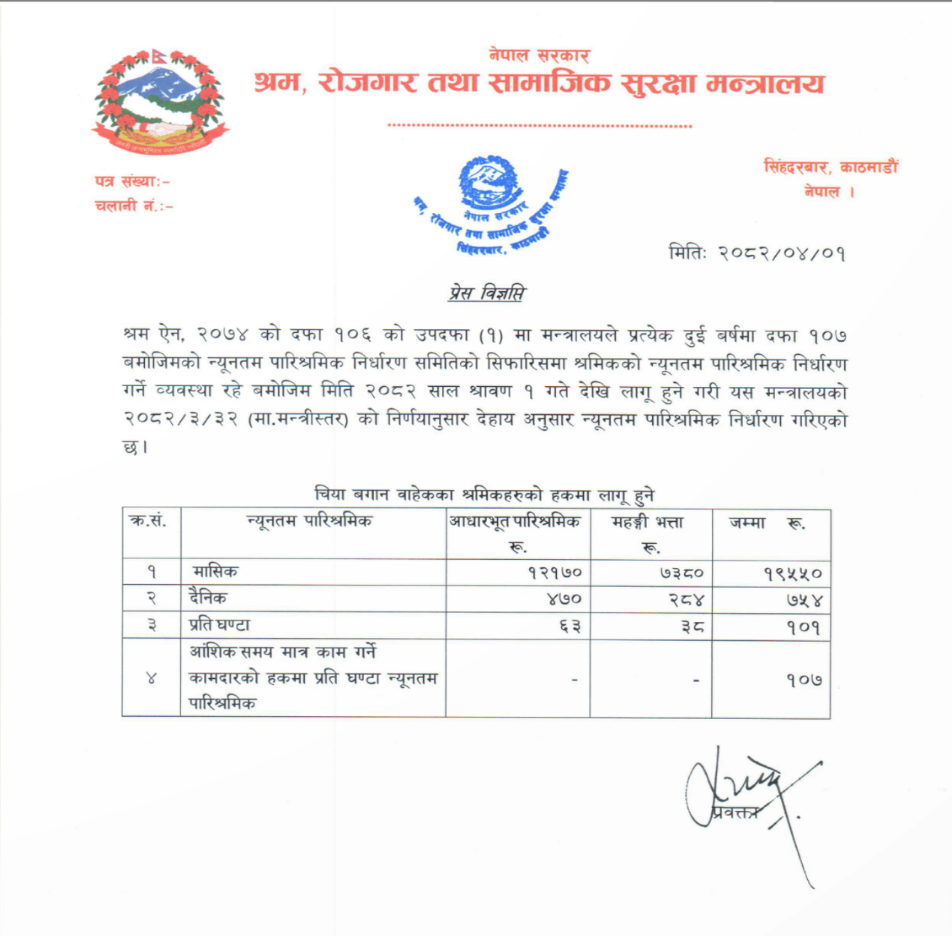
The Ministry of Labour, Employment and Social Security of Government of Nepal has issued a press release revising the minimum wage structure, effective from 01 Shrawan 2082 (17 July 2025).

Based on recommendations of the Minimum Wage Determination Committee, the new wage structure sets the minimum monthly remuneration at NPR 19,550, which includes a basic salary of NPR 12,170 and a dearness allowance of NPR 7,380. Similarly, the daily and hourly wage rates are now fixed at NPR 754 and NPR 101, respectively, with part-time hourly workers entitled to NPR 107.

The revised minimum wage structure is as follows:

S.N.Minimum Wage CategoryBasic Salary (Rs.)Dearness Allowance (Rs.)Total Monthly Wage (Rs.)
1.Monthly12,1707,38019,550
2.Daily470284754
3.Hourly6338101
4.Part-Time (per hour)107


This updated wage structure applies to all workers except those in the tea-estate sector and is mandatory for all employers across Nepal. The minimum wage increment notice has also been published in the Nepal Gazette on 05 Shrawan 2082 (21 July 2025) by Ministry of Labour, Employment and Social Security of Government of Nepal, full text of which can be accessed from here.

Overview of Directives for Managing the use of Social Media, 2080 (2023)

The Ministry of Communication and Information Technology under Government of Nepal introduced Directives for Managing the use of Social Media, 2080 (2023) (“Social Media Directives”) through publication in Nepal Gazette dated 27 November 2023.  The Social Media Directives establishes a regulatory framework for the operation, oversight, and compliance of social media platforms within Nepal.

This article provides for the general overview of the Social Media Directives, enlistment requirements, classification of social media platform, and other compliance requirements for social media platforms and social media users.

I. Definition

The definitions under the Social Media Directives are as follows:

a. Social Media: A media, including group, blog, app which provides facilities to any person, group or organization to communicate interactively with each other and to broadcast content created by users in accordance with the facilities and methods provided by the social media platform through electronic means of communication such as computer, internet.

b. Social Media Platform: A publicly available system based on the internet or information technology, such as Facebook, Tiktok, Twitter, Viber, Pinterest, Whatsapp, Messenger, Instagram, Youtube, Linkedin, WeChat, etc, that allows an individual or organization to exchange ideas or information with each other or provides facilities to disseminate user-generated contents.

II. Social Media Platform Enlistment

Any individual, company, or organization intending to operate a social media platform must enlist with the Ministry of Communication and Information Technology (“Ministry”). If the social media platform fails to enlist, the Ministry can prohibit such platforms from operating within Nepal.

However, this provision does not apply to social media platforms that operate solely for the purpose of civic education and social empowerment.

III. Procedure for Enlistment of Social Media Platform

A. Applicable procedures

STEPSDescription
STEP 1Submit the online/offline application in prescribed format along with the required documents in person or through a representative at the Social Media Management Unit under the Ministry.
STEP 2 If the Social Media Management Unit, upon examination of the application, finds the details appropriate, the social media platform will be provided with a Memo of Enlistment.

Note: In case of online application, submit the application and required documents in the email: snru@mocit.gov.np.

B. Required documents

a) For the company/organization with head office in Nepal

S.N.Description
    i.           Memorandum of Association and Articles of Association of company/organization;
  ii.           Registration certificate of company/organization;
iii.            PAN/VAT certificate of company/ organization;
 iv.            Update letter of company;
   v.            Certificate of latest tax clearance;
 vi.            Company minutes related to decision of enlistment;
vii.           Details of shareholders registry;
viii.            Details of foreign investors investing in shares, if any;
 ix.           Details of Board of Directors of company/ organization;
   x.            Citizenship certificate for Nepali citizen and copy of passport for foreigner;
 xi.           Privacy policy, data usage policy, information security policy;
xii.           Documents related to technical ability and professional competence;
xiii.            Video KYC of authorized representative in case of online application;
xiv.            Standards prescribed by social media in relation is its users;
xv.            Process of grievance handling mechanism in social networks; and
xvi.            Other necessary details.

b) For the company/organization with head office in other country

S.N.Description
    i.           Memorandum of Association and Articles of Association of company/organization;
  ii.           Registration certificate of company/organization;
iii.            PAN/VAT certificate of company/ organization;
 iv.            Certificate of latest tax clearance;
   v.            Company minutes related to decision of enlistment;
 vi.            Copy of passport of authorized representative;
vii.           Video KYC of authorized representative in case of online application;
viii.            Standards prescribed by social media in relation is its users;
 ix.           Process of grievance handling mechanism in social networks; and
   x.            Other necessary details.

IV. Prohibition for social media users 

The Social Media Directives provides for responsibilities on all users of social media platforms in Nepal and outlines a comprehensive list of prohibited behaviours aimed at ensuring ethical, lawful, and respectful online conduct. General prohibitions include:

a) Create an anonymous or disguised identity (fake ID, pages, group);

b) Produce and share content or share other’s content or comment on other’s content or make calls anonymously or with disguised identity (fake ID, page, group);

c) Target any person, community, caste, sex, religion, age, color, class, profession, sect, marital status, family status, physical or mental condition, origin, sexual orientation, language and other groups or category of people protected by law to spread hatred, or share word, audio, visual, picture that harm social harmony and tolerance and to create, publish and broadcast trolls;

d) Encourage child labour, human trafficking, polygamy, child marriage, caste untouchability and other activities prohibited by prevailing laws;

e) Create offensive words, audio visuals, images, trolls with an intention to bully others and use  hateful expressions, defamation, or acts that constitute hate speech; 

f) Perversely modify the photograph of a person by animation, montage and other technology through the use of digital media and publish or broadcast such photograph;

g) Edit, publish and broadcast without permission, the photographs and videos of private matters other than those of a public nature;

h) Publish, broadcast or comment in support of obscene word, photograph, audio, video animation;

i) Encourage content that harms child and promotes prohibited activities including child sexual exploitation, sexual abuse, prostitution;

j) Publish or broadcast false information, misleading information, misinformation, disinformation; and 

k) Commit act that constitutes cyber bullying.

V. Classification of Social Media Platforms

Social Media Directives classify social media platforms based on their user base, as detailed below:

a) Small Social Media Platform: Platforms with fewer than 100,000 users.

b) Large Social Media Platform: Platforms with more than 100,000 users.

VI. Point of Contact

Operators of social media platforms are subject to compliance requirements, including:

  • Appoint a designated contact person based in Nepal.
  • Establish a grievance handling officer.
  • Maintain a content moderation unit for Nepal-specific content.

VII. Social Media Management Unit

The Social Media Management under the Ministry is responsible for monitoring compliance with the Social Media Directives and resolving user grievances related to social media use in Nepal.

VIII. Duties of Social Media Platform Operators

The Social Media Directives outlines responsibilities for operators of social media platforms operating in Nepal, including the following:

  1. Algorithmic Control: Operators must develop and implement algorithms capable of detecting and limiting the publication, promotion, or advertisement of content that violates prevailing Nepali laws.
  2. Timely Content Removal: Upon receiving a valid grievance or an order from the Social Media Management Unit (SMMU), operators must remove unlawful or objectionable content within 24 hours.
  3. Data Privacy and Security: Platforms are required to adopt robust data security measures and ensure the confidentiality of user information.
  4. Transparency in Moderation: Operators must align their content moderation policies with international standards, particularly the Santa Clara Principles on transparency, due process, and accountability.
  5. Legal and Financial Compliance: All monetary transactions related to the platform’s operations in Nepal must be conducted through recognized banking channels, ensuring financial transparency and regulatory compliance.

IX. Duties of Social Media Users

Social media users in Nepal are also held accountable under the Social Media Directives, with specific responsibilities including:

  1. Upholding National Interest: Users are strictly prohibited from publishing, promoting, or interacting with content that undermines Nepal’s sovereignty, territorial integrity, national unity, security, or intergovernmental harmony.
  2. Avoiding Hate and Division: Content that promotes religious or communal hatred is strictly forbidden.
  3. Indirect Engagements Also Restricted: Not only is publishing prohibited, but so is liking, sharing, commenting, tagging, live-streaming, reposting, subscribing to, or mentioning any content that is classified as illegal under the Social Media Directives.

Disclaimer: This article is for general informational purposes only and does not constitute legal advice, advertisement, personal communication, solicitation or inducement. No attorney-client relationship is created through this content. Gandhi & Associates assumes no liability for any consequences resulting from actions taken based on information contained herein.

For quick legal assistance:

Phone/Viber/WhatsApp: +977 9709035477

For specific legal advice regarding social media platform enlistment in Nepal, please contact our office to schedule a consultation with our experts.

Overview of Data Center and Cloud Service (Operation and Management) Directives, 2081 (2024)

The Ministry of Communication and Information Technology under Government of Nepal introduced Data Center and Cloud Service (Operation and Management) Directives, 2081 (2024 A.D)  (“Data Center and Cloud Service Directives”) which was approved by ministerial level on 2081.10.15. Data Center and Cloud Service Directives seek to enhance data security, ensure data sovereignty, and promote efficient service delivery across both public and private sectors.

This article provides for the general overview of the Data Center and Cloud Service Directives, enlistment requirements for data centre and cloud sservice providers, tier rating, and other compliance requirements.

I. Definitions

The key definitions under Data Center and Cloud Service Directives are as follows:

a. Data Centre: A center with the necessary infrastructure for the storage of data and the operation of information technology systems by the government, public and private sectors.

b. Cloud Service: The hardware and software-integrated infrastructure prepared by a data centre service provider or other entity to operate (host) information technology systems developed by the government, public and private sectors.

c. Data: A formal representation of information, knowledge, or instructions gin the form of letters, numbers, images, sounds, or audio-visuals that are being formally prepared or have been prepared for its use in a computer, computer system, or computer network, or produced by a computer, computer system or computer network.

II. Enlistment Requirements

All data centers and cloud service providers must register with the Department of Information Technology (“DOIT”) before commencing operations.

Existing service providers must apply for registration within six months of the Directive’s enforcement date, i.e., by July 31, 2025 (as the Directive was enacted on January 28, 2025).

III. Required Documents

S.N.Documents
1.       Company or firm registration certificate
2.      Security and privacy policy
3.      Business Continuity Plan (BCP)
4.      Technical personnel details
5.      IP pool details
S.N. Additional documents for Data CentreAdditional documents for Cloud Services
1.       Fire safety assurance certificateAgreement with a registered data center
2.      Building completion certificateISP/NSP affiliation details
3.      Tier classification of the data center (Tier I, II, III, or IV)Information Security Related Standard certificate
4.      Physical security methods usedIT Service Management Standard certificate
5.      High-level electrical design and layout 
6.      Agreement with land/building owner (if rented) 
7.      Information Security Standard certificate for both Data Center (DC) and Disaster Recovery (DR) 

Upon receiving all required documents, DOIT will conduct a physical inspection of the infrastructure. If satisfied, DOIT will issue a Certificate of Enrollment within one month from the date of application. Also, DOIT holds the authority to cancel the enrollment if the service provider is found in violation of the Data Center and Cloud Service Directives.

IV. Tier rating of the data centre

Data Centers will receive a “Tier Rating” based on their physical infrastructure and services, categorized as:

CriteriaTier 1Tier 2Tier 3Tier 4
Distribution Path (Power/Cooling)111 Active / 1 Alternative2 Active
Redundant Active ComponentNNN+12(N+1)
Redundancy – BackboneNoNoYesYes
Redundancy – Horizontal CablingNoNoNoOptional
UPS/GeneratorOptionalYesYesDual Systems
Concurrently MaintainableNoNoYesYes
Fault TolerantNoNoNoYes
Availability (Uptime/Year)99.671%99.749%99.982%99.995%
Maximum Downtime/Year< 28.8 hours< 22 hours< 1.6 hours< 26.3 minutes
Power Backup Requirement12 hours12–24 hours24–48 hours48+ hours

The data center service provider must submit the tier rating certificate to the DOIT within one year of listing. Further, any data centre storing governmental data must have at least 3 3-tier rating or above.

V. Compliance Requirements for Data Center and Cloud Services in Nepal

Under the Data Center and Cloud Service Directives, the following compliance obligations are imposed on data center and cloud service providers:

a) Service providers must conduct annual security audits and submit compliance reports to the Department of Information Technology (DOIT), verifying adherence to data security and operational standards.

b) Each service provider must either:

  • Appoint a dedicated compliance officer, or
  • Collaborate with an authorized institution to ensure conformity with international best practices and standards (such as ISO/IEC 27001, ITIL, etc.).

c) In the event of any unauthorized access or security breach, the service provider is obligated to:

  • Immediately notify the relevant authority (DOIT), and
  • Take prompt remedial actions to mitigate the breach.

d) Service Providers must ensure the development and maintenance of a secure, resilient infrastructure, which includes:

  • High-standard technical equipment (e.g., servers, network switches, racks, storage systems, HVAC systems)
  • Physical and digital security systems, including access control, CCTV, and fire safety mechanisms
  • Continuous monitoring of network and infrastructure integrity.

VI. Removal of Enlistment of Data Center and Cloud Service Providers

Under the Data Centre and Cloud Service Directives, the DOIT can remove a service provider from its official registry under the following circumstances:

a. Voluntary Cancellation: A service provider may submit a formal request for cancellation of its registration. Upon verification, the Department may approve and process the removal.

b. Non-Compliance: The Department reserves the right to cancel the enlistment if the service provider:

  • Fails to comply with the provisions of the Directive,
  • Neglects to maintain required standards, or
  • Does not submit mandatory documents or updates as required by the regulatory framework.
VII. Integrated Data Management Center

The Data Centre and Cloud Service Directives provides for the establishment of Integrated Data Management Center (the “Center”) for the purpose of ensuring robust infrastructure for government digital operations. Its primary responsibilities include:

  • Infrastructure Management: Provision of colocation facilities and necessary technical infrastructure for government IT systems.
  • Continuity of Services: Ensuring the uninterrupted operation of cloud and virtual resources for government systems in alignment with Service Level Agreements (SLAs).

Disclaimer: This article is for general informational purposes only and does not constitute legal advice, advertisement, personal communication, solicitation or inducement. No attorney-client relationship is created through this content. Gandhi & Associates assumes no liability for any consequences resulting from actions taken based on information contained herein.

For quick legal assistance:

Phone/Viber/WhatsApp: +977 9709035477

For specific legal advice regarding data centre and cloud service enlistment in Nepal, please contact our office to schedule a consultation with our experts.

Gandhi & Associates is proud to welcome back Mr. Raju Man Singh Malla as Senior Partner

A distinguished figure in the legal and civil service landscape, Mr. Malla returns to the firm with decades of experience in legislative drafting, international consultancy, and public service. His previous contributions played a pivotal role in shaping the firm’s growth and reputation, and we are honoured to have him rejoin us as Head of the Consultation and Advisory Division.

Mr. Raju Man Singh Malla

Mr. Malla’s unwavering integrity, visionary leadership, and deep legal expertise continue to inspire generations of professionals. His return marks not just a homecoming, but a renewed commitment to the excellence that defines Gandhi & Associates.

We are privileged to welcome him back to the G&A family and look forward to the enduring impact of his leadership.

Gandhi and associates team

Overview of Social Media Bill, 2081 (2025)

I. Introduction

The Social Media Bill, 2081 (2025) (“Social Media Bill”) is a proposed legislation introduced by the Government of Nepal to regulate digital platforms such as Facebook, TikTok, YouTube, and X (formerly Twitter). Tabled in the National Assembly in early 2025, the bill seeks to require social media platforms to register in Nepal, appoint legal representatives, and promptly remove content deemed harmful or illegal by the authorities.

As of mid-2025, the bill remains under parliamentary review and has not yet been passed into law.

II. Definition of Social Media and Platform

The Social Media Bill defines the terms “Social media” and “Platform” under Section 2, as detailed below:

Social media refers to any system that enables interactive communication or dissemination of content between and among individuals, groups, or institutions in accordance with the facilities and processes made available through electronic technologies and devices, including computers, computer networks, and the internet.

Platform means an application, website, blog, AI tools, or other similar publicly accessible social media platform created in cyberspace through electronic technology, designed to enable interaction or exchange of thoughts or information among internet users, including between individuals, between individuals and groups or institutions, or between groups and institutions.

III. Licensing and Registration of Social Media Platforms

A company, firm, or institution intending to operate social media platforms in Nepal must obtain a license from the Department of Information Technology. This obligation applies equally to platforms operated from outside Nepal that serve users within the country.

   Application Requirements

Applicants must submit an application, via its representative or online medium, in the prescribed format along with the following documents:

S.N.Required Documents
1.Copy of registration certificate of the company, firm, or institution
2.Copy of Memorandum and Articles of Association (if applicable)
3.Copy of PAN certificate
4.Shareholder information
5.Details of foreign investment (if applicable)
6.Updated company records
7.Details of board of directors or governing body
8.Board resolution approving the license application
9.Authority letter for application submission
10.Citizenship or passport copy of authorized representative
11.Privacy policy, data use and security policies of the platform
12.User content moderation standards applied by the platform
13.Identity documents of local representative (for foreign platforms)
14.Any other documents as specified by the Department of Information Technology

Note: Social media platforms enlisted with the Ministry of Communication and Information Technology prior to the enactment of the law must reapply within 6 months of this law coming into effect.

IV. Validity, Renewal, and Cancellation of Licenses

A. Validity and Renewal

A platform operation license will remain valid for a period of 2 years. To ensure continuity of operation, the license holder must submit a renewal application at least 15 days prior to the expiration date. The renewal application must be submitted in the prescribed format and be accompanied by relevant documentation, as listed below:

S.N.Required Documents for Renewal
1.Report on security mechanisms used in the platform
2.Summary of complaints and resolution from the past fiscal year
3.Details of corporate social responsibility initiatives
4.Tax clearance certificate
5.Annual report of major activities conducted via the platform

Note: Failure to renew within time will result in automatic revocation of the license.

B. Grounds for Cancellation

The license granted to a social media platform may be subject to cancellation on several specific grounds as outlined below:

S.N.Grounds for License Cancellation
1.       Spreading content that disrupts national unity or sovereignty
2.      Breach of licensing conditions or submission of false information
3.      Failure to appoint a contact point within Nepal (for foreign platforms)
4.      Absence of a complaint resolution mechanism
5.      Non-compliance with official instructions

License holders will be given 15 days to justify why the license should not be revoked. If unsatisfactory, a cancellation order will be issued, with a right to appeal to the Ministry of Communication and Information Technology within 35 days.

V. Prohibition on Unlicensed Operation

Any platform operating without a license, or after license revocation, will be barred from operating in Nepal. The Department of Communication and Information Technology will instruct the Nepal Telecommunications Authority to direct internet service providers to block access.

VI. Appointment of Local Contact Point

Foreign platforms must designate a Nepal-based contact point within 3 months of the law’s commencement. This entity will be responsible for grievance handling and official correspondence.

VII. Grievance Redressal Mechanism

In order to ensure accountability and responsiveness, the Social Media Bill requires all licensed platforms to establish a comprehensive grievance redressal mechanism. The platform operator must establish a rapid response team, maintain a 24/7 complaint handling officer, monitor adherence to self-regulation standards, and publicly disclose changes in contact persons or complaint officers.

VIII. Obligations of Social Media Users

Social media users are required to abstain from the following acts:

S.N. Prohibited User Conduct
1.       Using abusive, defamatory, or hateful speech
2.       Disseminating false, misleading, or distorted information
3.       Advertising or engaging in activities prohibited by law
4.       Sharing or copying illegal content
5.       Promoting superstition or content harmful to public health

Note: Violation may result in penalties of up to NPR 500,000.

IX. Compliance Obligations of Licensed Platforms

To maintain compliance with the law and foster a safe digital environment, licensed platforms are subject to a set of operational obligations.

S.N.  Obligations of Platforms
1.       Prevent dissemination of harmful, hateful, or illegal content
2.       Protect user data and privacy, except as required by law
3.       Raise awareness on digital safety and media literacy
4.       Ensure identity verification of users (no anonymous use)
5.       Establish banking-based payment systems for transactions
6.       Cooperate with investigations by providing user data

Note: Non-compliance may attract fines ranging from NPR 2.5 million to NPR 10 million.

X. Regulatory and Enforcement Authorities

    The following bodies will function as relevant authorities for the implementation purpose:

S.N. Relevant Authorities
1.       Nepal Police
2.       Nepal Telecommunications Authority
3.       Press Council Nepal
4.       Department of Information and Broadcasting
5.       Advertisement Board
6.       Other agencies designated by the Government

XI. Offense and Penalties

S.N.DescriptionPenalties
1.  Operating without obtaining social media platform license, even after stop oderFine up to NPR 2,500,000
2Use of insulting, abusive, trolling, or hate speech content intended to harm someone’s reputation through posts, comments, tags, likes, livestreams, etc.Fine up to NPR 500,000
3Activities that threaten national integrity or incite hatred based on protected characteristics.Up to 5 years in prison or a fine of NPR 500,000, or both
4Repeated online posts or messages intended to harass or harm.Up to 2 years in prison or a fine of NPR 300,000, or both
5Repeated, unwanted digital attention causing fear or distress.Up to 3 years in prison or a fine of NPR 500,000, or both
6Unauthorized access to someone’s account or personal data, or impersonation and phishing scams.Up to 3 years in prison or a fine of NPR 1.5 million, or both
7Use of social media for coercion, blackmail, or demanding money or favors.Up to 3 years in prison or a fine of NPR 1.5 million, or both
8Uploading or sharing obscene audio, images, or videos.Up to 3 months in prison or a fine of NPR 50,000, or both
9Creation or distribution of deepfake content.Up to 2 years in prison or a fine of NPR 300,000, or both
10Circulating false, misleading, or obscene content.As per offense
11Creating or using accounts under false or hidden identities.Up to 3 months in prison or a fine of NPR 50,000, or both
12Creation of fake pages/accounts to mislead or harm national security.Up to 5 years in prison or a fine of NPR 1.5 million, or both
13Repeat offenders face double penalties. Public officials or those benefiting from public funds face 50% increased penalties. Using children results in an extra 1-year prison term.Depends on the offense

Disclaimer: This article is for general informational purposes only and does not constitute legal advice, advertisement, personal communication, solicitation or inducement. No attorney-client relationship is created through this content. Gandhi & Associates assumes no liability for any consequences resulting from actions taken based on information contained herein.

For quick legal assistance:

Phone/Viber/WhatsApp: +977 9709035477

For specific legal advice regarding social media platform registration in Nepal, please contact our office to schedule a consultation with our experts.